Product Discovery: The Complete Guide for Product Teams

TL;DR: Product Discovery
Product discovery is the continuous work of understanding customers and validating their problems before you build, and it is the step most teams skip.
- The cost: 29,5 billion dollars a year go into software features that are rarely or never used.
- The process: Understand the problem, explore solutions, validate and learn, and repeat every week.
- The techniques: Ten techniques from interviews to assumption mapping, with the situation each one fits.
- Before you build: The five-step customer discovery process, from hypotheses to getting out of the building.
- The habit: Two 90-minute blocks a week, Tuesday and Thursday, and one insight shared every Friday.
Product discovery is the process of understanding your customers and validating their problems before you write a single line of code. It's the difference between building something people need and building something that collects dust. This guide covers the process, the frameworks, the ten techniques, customer discovery before you build, and how to make discovery a weekly habit.
From my coaching practice (September 2026). No customer wakes up in the morning thinking "I would love to log in faster with Google sign-in today." Plenty of companies build exactly that and call it a feature. Discovery, done right, is the habit of asking about the customer's day instead of about your idea: what they did the last time the problem came up, what it cost them, what they already tried. The seven questions I ask before a founder builds anything are in my product-market fit questions; this page is the method around them.
"When I asked 'who uses our product?' no one could answer." Esmar Mesic, Product Bakery Podcast
That moment of silence in a meeting room happens more often than you'd think. Teams spend months building features nobody wants because they skipped the most critical step in product development: discovery. Applying lean principles to this process means validating before building. $29.5 billion is wasted annually on software features that are rarely or never used, and that's not a development problem, it's a discovery problem.
What Is Product Discovery?
Product discovery is the continuous process of identifying and validating customer problems before building solutions. The goal is not just to understand what users say they want, it's to uncover problems worth solving and confirm that your proposed solution actually addresses them.
At its core, product discovery reduces four types of risk:
- Value risk: Will customers actually use this?
- Usability risk: Can they figure out how to use it?
- Feasibility risk: Can we actually build it?
- Viability risk: Does it make business sense?
The pattern I see across teams is that most skip straight to feasibility, "Can we build it?" without first establishing whether anyone needs it. If you address a problem that no one has or cares about, you've wasted time and money. This is why more than 90% of startups fail.
Product discovery doesn't happen in isolation. It shapes your long-term product vision and informs strategic product decisions at every level of the organization.
What Product Discovery Is NOT
Let me be direct about common misconceptions:
Discovery is not asking customers "What problem do you have?" That approach leads nowhere. Instead, you need a hypothesis to validate. You should inquire about specific problems and how people currently address them.
Discovery is not a phase you complete once. It's continuous. User behaviors shift, technologies advance, and market dynamics change. A one-time discovery effort, no matter how thorough, becomes outdated quickly. In my coaching experience, the teams that struggle most are those who treat discovery as a project with an end date rather than an ongoing practice.
Discovery is not just the PM's job. Engineers, designers, marketers, and customer support all bring unique insights. Cross-functional collaboration enriches the process and prevents blind spots that single-discipline teams inevitably develop.
Product Discovery vs Product Delivery
One of the most common sources of confusion in product teams is the relationship between discovery and delivery. They are complementary activities, not sequential phases.
| Dimension | Product Discovery | Product Delivery |
|---|---|---|
| Goal | Reduce uncertainty, find the right thing to build | Reduce risk, build the thing right |
| Output | Validated hypotheses, prototypes, evidence | Working software, shipped features |
| Timeline | Continuous, parallel to delivery | Sprint-based or continuous deployment |
| Key question | "Should we build this?" | "How do we build this?" |
| Failure mode | Building the wrong thing | Building the right thing poorly |
| Who leads | Product Manager + Designer | Engineering Lead + Product Manager |
When I work with teams, I often find that discovery and delivery are treated as separate tracks owned by different people. The healthiest teams run both activities in parallel: discovery feeds delivery with validated ideas that become user stories and epics in the product backlog, and delivery feedback informs the next round of discovery.
The Product Discovery Process
The product discovery process follows a pattern that balances divergent thinking (exploring possibilities) with convergent thinking (narrowing down to solutions). Here's the overview:
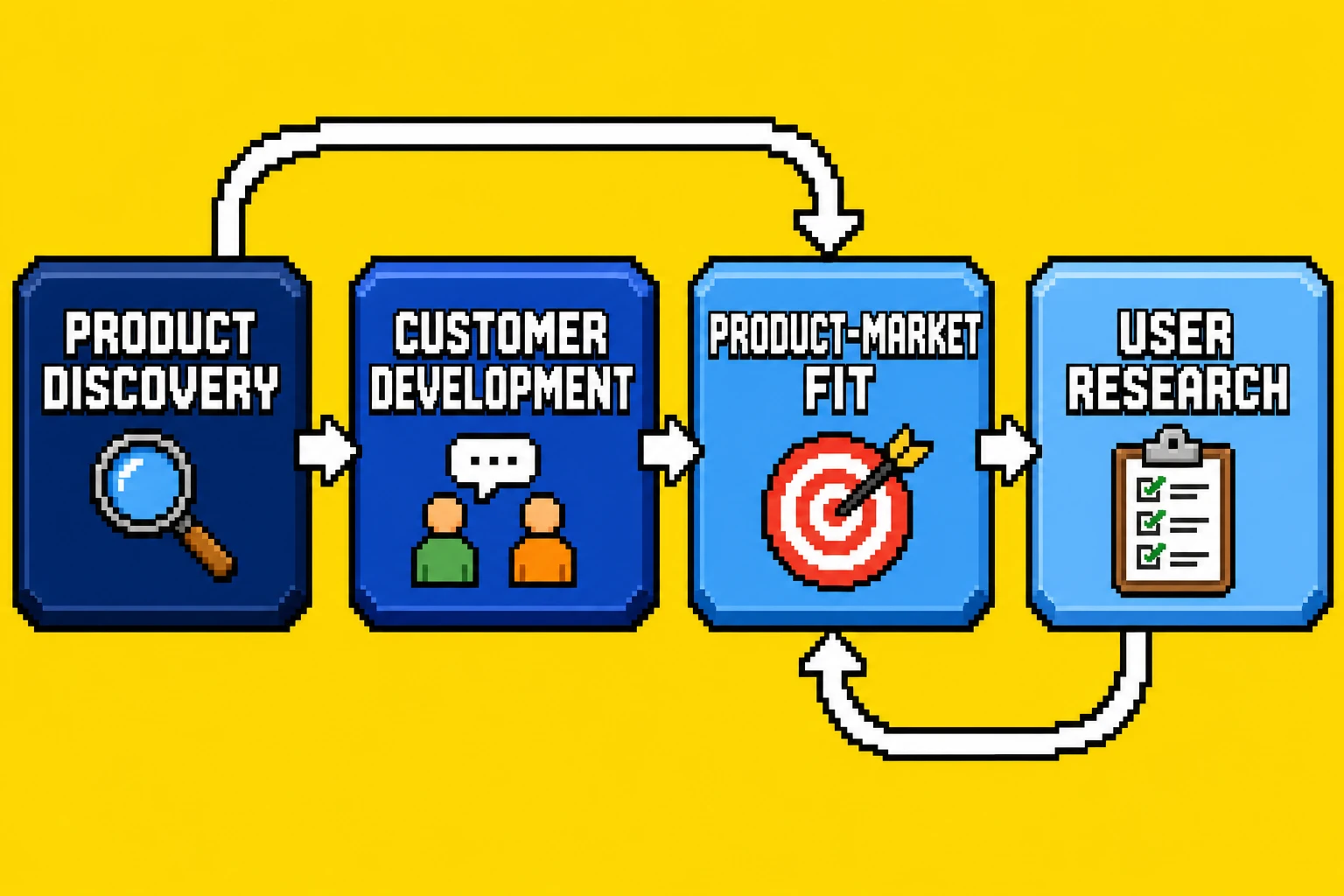
Phase 1: Understand the Problem
The first phase focuses on engaging with potential customers through structured conversations. The professional approach is called customer interviews, asking open-ended questions related to a specific problem or hypothesis you want to validate. This is where customer discovery techniques become essential.
"Customer development focuses on solutions that solve customer problems AND can be sustainably built." Cindy Alvarez, GitHub
Key principles for this phase:
- Start with a hypothesis, not a blank slate
- Ask about past behavior, not future intentions
- Focus on problems, not solutions
- Listen more than you talk
Once you understand your customers' challenges, you move closer to achieving product-market fit. Remember: a single conversation won't give you all answers. Engage regularly, because behaviors and needs evolve.
Phase 2: Explore Solutions
In the second phase, you validate your user experience and interface solutions. You're testing the solutions you've developed against real user behavior. For a comprehensive breakdown of all available research techniques and when to use each, see my guide to user research methods. To build a systematic approach, follow the UX research process framework.
"Five to seven users per segment. That's the magic number for usability testing." Nikki Anderson, Zalando
This phase involves presenting solutions, letting users test your product, and observing silently while taking notes. Prototypes work best here, they're quick and cost-effective ways to validate ideas before committing development resources.
Phase 3: Validate and Learn
True validation only comes when your product is live. That's the moment of truth. But here's my philosophy: I don't believe in labeling outcomes as "wrong." Every outcome is a learning opportunity. You don't fail, you learn.
"It's not an experiment if you're not willing to kill the idea." Josh Seiden, Lean UX
In my coaching experience, the hardest part of this phase is not the testing itself, it's getting teams to act on what they learn. I've seen teams run experiments perfectly, get clear negative signals, and still proceed with building the feature because they were emotionally invested. The discipline to kill ideas based on evidence is what separates great product teams from average ones.
Product Discovery Frameworks
Several frameworks can structure your discovery work. Each serves a different purpose, and the best teams often combine elements from multiple approaches.
Double Diamond
The Double Diamond framework divides discovery into four phases:
- Discover: Research and explore the problem space
- Define: Synthesize findings and focus the problem
- Develop: Generate and prototype solutions
- Deliver: Test and refine the final solution
The framework's strength is its simplicity. It makes the diverge-converge pattern visible, which helps teams understand when to explore broadly and when to narrow down.
Opportunity Solution Trees
Developed by Teresa Torres, Opportunity Solution Trees (OSTs) visualize connections between desired outcomes, opportunities (problems), and possible solutions. Start with a clear outcome at the top, map customer opportunities below, then brainstorm multiple solutions for each opportunity.
OSTs prevent teams from jumping straight to solutions. They force you to articulate what outcome you're trying to achieve and what customer problems stand in the way. This structure helps prioritize which problems to solve first based on impact.
Jobs-to-be-Done (JTBD)
Jobs-to-be-Done focuses on understanding the underlying motivations and desired outcomes of users, not just their stated wants. JTBD asks: what job is the customer hiring your product to do?
A customer doesn't buy a drill because they want a drill. They want a hole in the wall. But they don't even want the hole, they want to hang a picture. Understanding this chain of motivation helps you build products that truly solve the underlying need.
| Framework | Best For | Team Size | Learning Curve | Key Strength |
|---|---|---|---|---|
| Double Diamond | Broad problem exploration | Any | Low | Simple diverge-converge model |
| Opportunity Solution Trees | Continuous discovery habits | Small-medium | Medium | Outcome-driven prioritization |
| Jobs-to-be-Done | Understanding user motivation | Any | Medium-High | Deep insight into why users switch products |
Most frameworks share the same core principles: understand the problem deeply, talk to customers and validate assumptions, prototype solutions and test them, then build, launch, and learn. The framework you choose matters less than consistently applying discovery thinking.
Product Discovery Techniques
Rather than mastering every technique, the key is choosing the right method for your current discovery situation: you don't know the problem yet, you have assumptions to test, you need to validate a solution, or your stakeholders disagree. Here's the selection guide, then the ten techniques in that order:
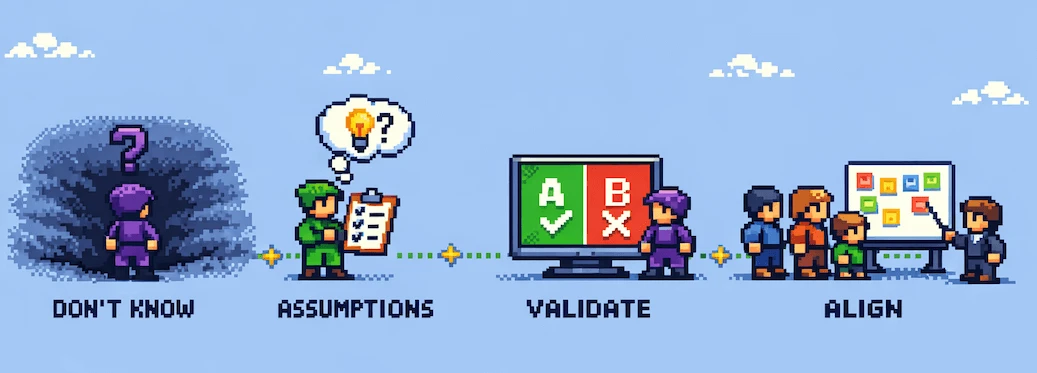
| Technique | Phase | When to Use | Effort | Best Output |
|---|---|---|---|---|
| Customer Interviews | Understand | Validating problem hypotheses | Low | Problem validation, behavioral patterns |
| Observational Studies | Understand | Uncovering hidden behaviors | Medium | Workflow insights, workaround discovery |
| Surveys | Understand | Quantifying known patterns at scale | Low | Statistical validation |
| Competitive Analysis | Understand | Identifying market gaps | Medium | Opportunity mapping |
| Prototyping | Explore | Testing solution concepts cheaply | Medium | Usability feedback, design direction |
| User story mapping | Explore | Visualizing user journeys for planning | Medium | Shared understanding, backlog structure |
| A/B Testing | Validate | Optimizing existing features | Medium | Data-driven decisions |
| Analytics Review | Validate | Understanding actual user behavior | Low | Drop-off points, usage patterns |
| Stakeholder workshops | Any | Aligning cross-functional teams | Medium | Shared priorities, internal insights |
When you don't know the problem
1. Customer interviews are the foundation of all discovery work. They only work when you ask about past behavior, not future intentions: "tell me about the last time you faced this problem" instead of "would you use this feature?". Hypothetical questions predict nothing. What to ask, by phase, is in my user interview questions. They fail when you run 30 interviews without synthesising between rounds.
2. Observational studies mean sitting next to a user (or on a screen share), staying quiet, and watching them work through a real task. A user says their process takes "about 10 minutes"; observation shows 45 minutes and 12 context switches. That gap is where product opportunities live. They fail when you observe without a research question and drown in notes.
3. Jobs-to-be-done interviews ask what job the user is hiring the product to do, what progress they are trying to make. In my coaching work it is the fastest way to move a team from feature-first to problem-first. A B2B team I coached stopped asking "what features do you need?" and started asking "what progress are you trying to make?", and found their users did not want a better dashboard. They wanted to spend less time in dashboards. They fail when the interviewer drifts back to feature questions.
When you have assumptions to test
4. Prototyping puts a low-cost version of the solution in front of users, from paper sketches to a clickable Figma flow. Match the fidelity to the question: concept, paper; navigation, wireframe; visual detail, high fidelity. Going polished too early makes users critique the polish instead of the idea. Pair prototypes with usability tests.
5. Surveys answer "how many" after interviews answered "why". You can only ask about things you already know exist, so a survey cannot reveal a problem you have not imagined. Use them to size known pain points, never as the only discovery method.
6. Competitive analysis goes beyond feature lists: read the one-star reviews, the pricing page, the support forum. User frustration with a competitor is a map of your opportunities. It fails when you copy features without checking whether your users share the problem.
When you need to validate a solution
7. A/B testing lets the data decide between two versions. It needs traffic, a hypothesis, and a well-defined problem. Testing button colors while the flow underneath is broken is rearranging furniture in a burning building.
8. Analytics review shows what users actually do: funnels, drop-offs, adoption. A 70 % drop-off on step 3 is a signal, not an answer. Pair the "what" from analytics with the "why" from interviews or session recordings; the combination is the strongest discovery approach there is.
9. User story mapping lays the user's journey out step by step so the team sees gaps and priorities together. It is the bridge from discovery to delivery, and it shows which parts of the journey matter most for an MVP. How to run one: user story mapping. It fails when treated as a one-time exercise.
When stakeholders disagree
10. Assumption mapping is a workshop where the team lists every assumption behind the plan and plots each one by "how critical" against "how much evidence". A B2B SaaS team I coached had been deadlocked for six weeks; in one session they listed 14 untested assumptions, picked the three most critical and least validated, designed experiments that week, and had answers within two. It fails when the facilitator lets weak evidence pass as strong.
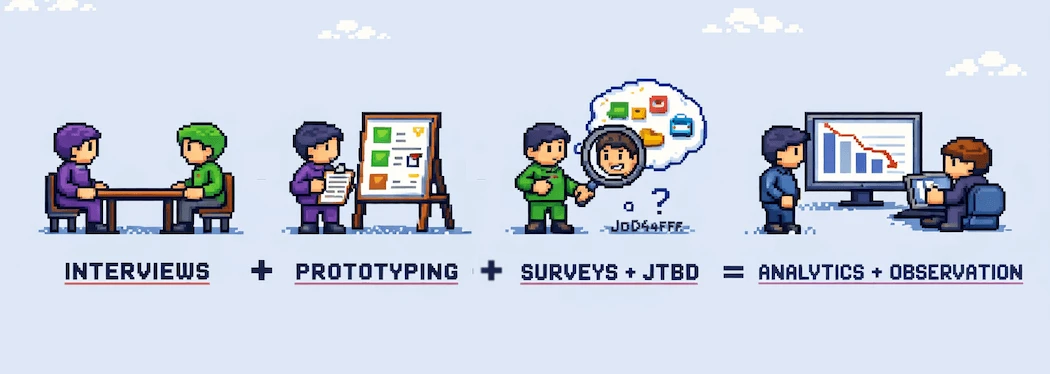
No single technique gives the full picture. The combinations that work compensate for each other's blind spots: interviews plus prototyping (why, then whether), surveys plus JTBD (how many, then what for), analytics plus session recordings (what, then why).
Customer Discovery: The Five-Step Process Before You Build
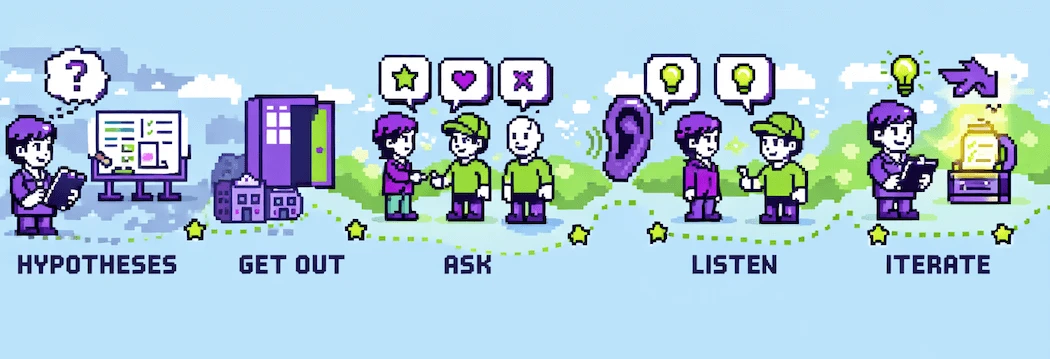
Customer discovery comes before product discovery: it answers who the customer is and whether they will pay, before you decide what to build. Five steps, from Steve Blank's customer development and from Cindy Alvarez's work at GitHub, are enough to run it.
Step 1: State your hypotheses. Write down the customer (who exactly), the problem (how painful), and the value (will they pay, how much). Discovery tests hypotheses; it does not start from a blank page.
Step 2: Get out of the building. Talk to real potential customers, not colleagues. Lightweight beats formal at the start: a question on LinkedIn, support conversations, forum threads, past sales calls. They tell you which questions to ask before you invest in interviews.
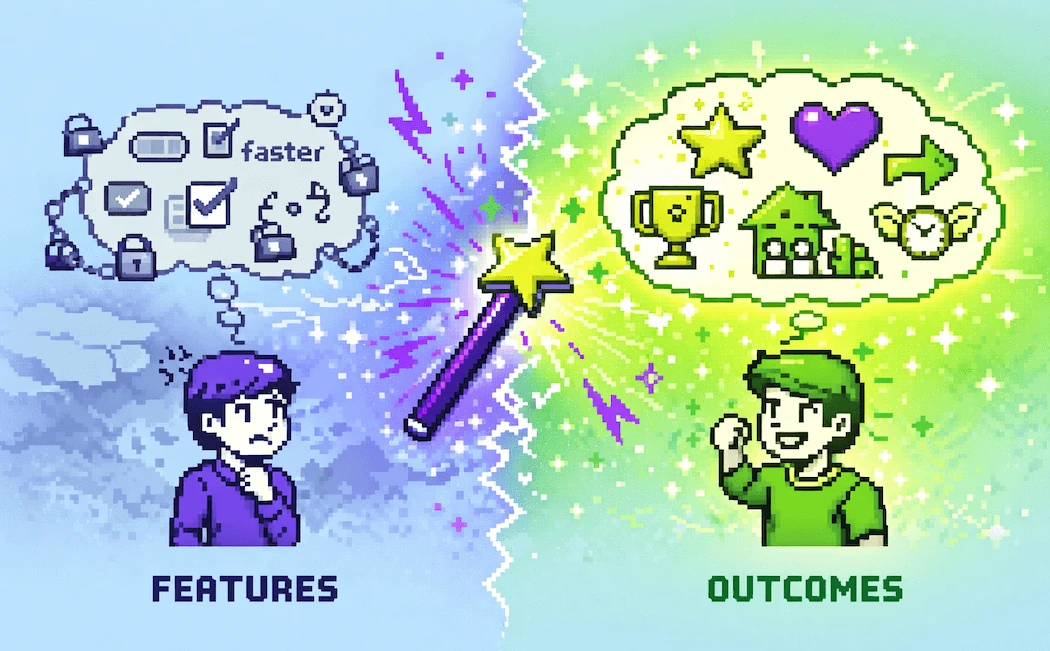
Step 3: Ask the right questions. Stock questions you can reuse without thinking on your feet: "What's the most important thing you need to solve in this area?", "Tell me about the last time you tried to do this. What happened?", "What's the hardest part?", "What have you tried before?", "What does this cost you in time or money?". When a conversation gets stuck, the magic wand question opens it: "If you could wave a magic wand, what outcome would you want?"
"You don't have to be super confident to ask a customer what's the most important thing you need to solve." Cindy Alvarez, GitHub
Step 4: Listen without bias. Record with permission, look for evidence against your hypothesis, count answers instead of remembering the flattering ones, and let a colleague without your emotional stake read the notes. Keep the customer's exact words; they become your product marketing later.
Step 5: Evaluate and iterate. After 15 to 20 conversations, each hypothesis is validated, invalidated or refined. Invalidated is not failure; it saved you months of building the wrong thing. Validated means you can build an MVP and keep learning through usability testing.
The practical difference between the two kinds of discovery:
| Dimension | Customer discovery | Product discovery |
|---|---|---|
| Core question | Who is the customer? Will they pay? | What should we build? What solves the problem? |
| When | Before building, when validating the market | Ongoing, when deciding what to build next |
| Output | Validated customer segment and value proposition | Roadmap, feature priorities |
| Methods | Problem interviews, landing page tests, smoke tests | Solution interviews, prototypes, usability tests |
| Risk addressed | Will customers buy this? | Can we build something customers want to use? |
Product Discovery Workshop
When I facilitate discovery workshops with product teams, the goal is to compress weeks of scattered discovery into focused, collaborative sessions. A well-run workshop aligns the team on what matters and produces actionable next steps.
| Block | Duration | Activity | Output |
|---|---|---|---|
| 1. Problem Framing | 60 min | Present data, define problem hypothesis | Shared problem statement |
| 2. Customer Evidence | 90 min | Review interview clips, survey data, support tickets | Evidence-backed problem validation |
| 3. Opportunity Mapping | 60 min | Build Opportunity Solution Tree as a team | Prioritized opportunity list |
| 4. Solution Sketching | 60 min | Rapid sketching of 3+ solution concepts | Diverse solution options |
| 5. Validation Planning | 30 min | Define experiments, assign owners | 2-week validation sprint plan |
The most common mistake in discovery workshops is jumping to solutions too quickly. Spend at least half the time in problem space before touching solutions. When I work with teams, I enforce a strict "no solutions until after lunch" rule, it forces the team to sit with the problem long enough to truly understand it.
Discovery workshops work best with 5-8 participants from product, design, and engineering. Include at least one person from customer-facing teams (support, sales) who brings the voice of the customer into the room.
Product Discovery Tools
The right tools support your discovery process without dictating it. Here's a vendor-neutral overview of what works for different team needs:
Jira Product Discovery integrates idea management directly into Atlassian's ecosystem. Teams already using Jira for delivery can connect discovery insights to backlog items without switching tools. Its strength is the prioritization framework that lets you score ideas against custom criteria.
Miro and FigJam excel at collaborative workshops and visual mapping. Use them for opportunity solution trees, affinity diagrams, and journey maps. They work well for remote and hybrid teams who need a shared visual workspace.
Dovetail specializes in research analysis, transcribing interviews, tagging insights, and identifying patterns across multiple conversations. It's particularly valuable when your team conducts regular customer interviews and needs to synthesize findings systematically.
The tool matters less than the habit. I've seen teams run excellent discovery with nothing more than a shared spreadsheet and a video call recorder. Start with the simplest tool that removes friction, then upgrade when the process demands it.
Product Discovery Template
I keep things lean and simple. Here's the template I use for my own discovery work:

A good discovery template captures four things: your hypothesis, the customer segment, the problem statement, and clear validation criteria. Feel free to adjust this to your needs, the structure matters more than the format.
Continuous Discovery: Building the Habit
The "build it and they will come" approach is dead. Continuous product discovery keeps users at the center throughout development, not just at the beginning.
"Starting with why is a big one. The more you explain that why, the more you empower teams." Cindy Alvarez, GitHub
Continuous discovery means making customer conversations a weekly habit rather than a quarterly project. It means every sprint has a discovery component alongside the delivery work. It means product trios (PM, designer, engineer) participate in research together rather than delegating it to a single researcher.
"Weekly" does not mean five full interviews a week. It means five to seven customer touchpoints spread across methods, about five to six hours per product manager:
| Day | Activity | Duration | What you learn |
|---|---|---|---|
| Monday | Analytics review | 30 min | Usage patterns, drop-offs, adoption trends |
| Tuesday | 2 customer interviews | 60 min each | Problems, motivations, context |
| Wednesday | Prototype usability test | 45 min | Solution validation, friction points |
| Thursday | Support ticket review | 30 min | Pain points, feature requests, confusion |
| Friday | Synthesis and share insights | 45 min | Patterns across the week, team alignment |
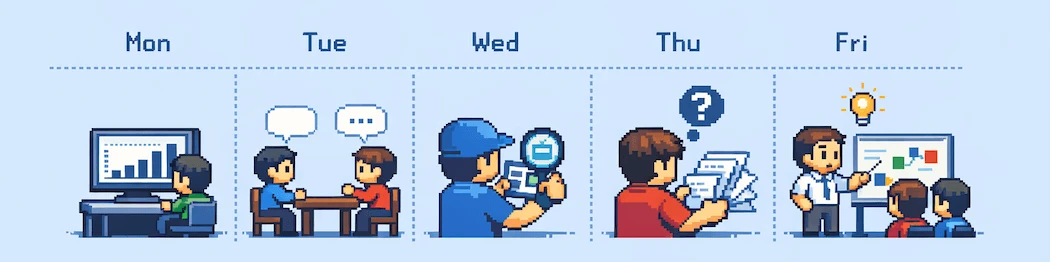
The mix is the point. Interviews alone become a qualitative echo chamber, analytics alone strip away context, support tickets alone bias you toward the loudest complainers. What keeps the cadence alive is a habit loop: a recurring calendar block as the cue (Tuesday and Thursday, 90 minutes, non-negotiable), the method rotated by what you need to learn this week as the routine, and one insight shared with the team every Friday as the reward. Batch the recruiting: five outreach messages every Monday morning through in-app messages, the newsletter or support follow-ups. Most teams fail not because customers refuse to talk, but because nobody asks.
The objection I hear most is "I don't have time for weekly research." The full cadence costs five to six hours a week. A two-week sprint with three engineers costs roughly 240 engineering hours; one misdirected sprint a quarter, because nobody talked to a customer, costs more than a year of weekly discovery.
The payoff is significant. Teams that practice continuous discovery build organizational muscle. Customer conversations become habit, not a one-time project. Cross-functional collaboration improves as engineers and designers participate directly in discovery. And when pivots are needed, the team has the research foundation to move quickly with confidence.
Getting Started with Product Discovery
Start small. Pick one hypothesis and run five customer interviews this week. You'll learn more in those conversations than months of internal debates.
Don't wait for perfect conditions. You don't need a formal research budget, a dedicated UX researcher, or executive buy-in to start talking to customers. Block an hour, reach out to five users, and ask about their problems. The insights you gather will speak for themselves, and often become the catalyst for organizational change.
If your team runs discovery and the roadmap still gets decided in a meeting without a customer in it, that is the situation I work on most as a product coach for startups. If you want to compare your discovery cadence with other builders first, build alongside other builders at Product Bakery, that is where I do that.