Scrum vs Kanban: Which Framework Fits Your Team?

TL;DR: Scrum vs Kanban
Scrum uses fixed sprints and Kanban uses continuous flow, and the right choice depends on your team's maturity and how predictable the work is.
- Choose Scrum: A new team with predictable work gets a playbook of roles and ceremonies to learn collaboration.
- Choose Kanban: A mature team with unpredictable work needs flow, visualized work and limits on work in progress.
- The numbers: 87 % of agile practitioners use Scrum and 56 % use Kanban, and many combine both.
- The truth: Teams debate the framework for weeks and then fail at the basics of either, so discipline matters more than the choice.
Scrum uses fixed sprints. Kanban uses continuous flow. That is the core difference, but choosing between them is rarely that simple. After coaching dozens of product teams through framework decisions, I have found that the real question is not "which framework is better?" It is "which framework fits your team's context right now?"
Scrum is a sprint-based agile framework with prescribed roles, events, and artifacts. Kanban is a flow-based system that visualizes work and limits work in progress. Both are agile methodologies, but they approach work management from fundamentally different angles. According to the 16th Annual State of Agile Report, 87% of agile practitioners use Scrum while 56% use Kanban, with many teams combining both.
In my coaching experience, teams spend weeks debating which framework to adopt, then struggle with the basics of either one. The framework matters less than the discipline to follow it. Here is an honest, vendor-neutral comparison to help you make the right call.
Here is the quick overview:
- Scrum: Fixed sprints, prescribed roles (Product Owner, Scrum Master, Dev Team), regular ceremonies, velocity-based metrics
- Kanban: Continuous flow, no prescribed roles, WIP limits per column, lead time and cycle time metrics
- Key difference: Scrum batches work into sprints. Kanban pulls work continuously.
- Best practice: Use the Framework Fit Matrix below to match your team's maturity and work predictability to the right framework
What Is Scrum?
Scrum is a lightweight agile framework built around fixed-length iterations called sprints. Each sprint typically lasts one to four weeks and follows a consistent pattern: plan the work, execute the work, review the results, reflect on the process.
The framework defines three roles. The Product Owner prioritizes work and represents stakeholders. They own the product backlog, decide what gets built next, and ensure the team is always working on the most valuable items. The Scrum Master facilitates the process and removes blockers. They are not a project manager but a servant-leader who protects the team's focus and coaches them toward better practices. The Development Team self-organizes to deliver the sprint goal. These three roles create clear accountability that prevents the "everybody owns it, nobody owns it" problem.
Scrum's strength is predictability. Teams commit to a sprint goal, protect that commitment from outside interference, and deliver a potentially shippable increment every sprint. This rhythm builds trust with stakeholders who can count on regular progress updates and working software. Over time, velocity data (story points completed per sprint) creates a reliable forecasting baseline.
"Two things usually cause project failures: missing transparency and not enough planning time."
The artifacts (product backlog, sprint backlog, and increment) create transparency. The events (sprint planning, daily standup, sprint review, and retrospective) create regular feedback loops. Sprint planning sets the direction. Daily standups surface blockers before they become crises. Sprint reviews collect stakeholder feedback on working software, not slide decks. Retrospectives turn team frustrations into concrete improvements. When teams avoid common sprint planning mistakes, Scrum becomes a reliable engine for iterative delivery.
The tradeoff is rigidity. Once a sprint starts, changes to the sprint backlog are discouraged. This protects focus but can frustrate teams dealing with urgent, unpredictable work. If your team routinely abandons sprint goals because "something urgent came up," that is a signal worth investigating. Either the work is genuinely unpredictable (consider Kanban) or the organization lacks discipline around commitments (a people problem, not a framework problem).
What Is Kanban?
Kanban is a flow-based method that originated in Toyota's manufacturing system and was adapted for knowledge work by David Anderson in the mid-2000s. Unlike Scrum, Kanban does not prescribe roles, sprints, or ceremonies. Instead, it focuses on four core principles: visualize your workflow, limit work in progress (WIP), manage flow, and make process policies explicit.
A Kanban board represents your workflow as columns (e.g., "To Do," "In Progress," "Review," "Done"). Work items flow continuously from left to right. Each column has a WIP limit that caps how many items can be in progress simultaneously. The board itself becomes a communication tool. Anyone can glance at it and understand what the team is working on, where bottlenecks exist, and whether work is flowing smoothly.
In my coaching experience, the biggest surprise for teams transitioning to Kanban is how hard it is to enforce WIP limits. Teams think Kanban means "no rules," but the opposite is true. A WIP limit of 3 means when 3 items are in progress, you must finish one before starting another. This constraint forces teams to address bottlenecks instead of piling up half-finished work. The most common Kanban failure I see is teams who set WIP limits, then immediately override them "just this once." That exception quickly becomes the rule, and the board becomes a wish list rather than a flow management tool.
The key Kanban metrics are lead time (total time from request to delivery), cycle time (time from work started to work completed), and throughput (number of items completed per time period). These metrics focus on flow efficiency rather than velocity. When lead time increases, something in your process is slowing down. When cycle time varies wildly, your process lacks consistency. These signals help teams improve without prescribing how to improve.
Kanban's strength is flexibility. There are no sprints to interrupt, no fixed planning cadence, and no prescribed roles. Teams can start with their existing process and evolve it incrementally. This "start with what you do now" principle makes Kanban particularly good for organizations that resist dramatic process changes.
The tradeoff is ambiguity. Without prescribed events or roles, teams must create their own discipline. Kanban requires maturity. Teams that lack self-organization skills can drift into chaos without the guardrails Scrum provides.
Scrum vs Kanban: The Key Differences
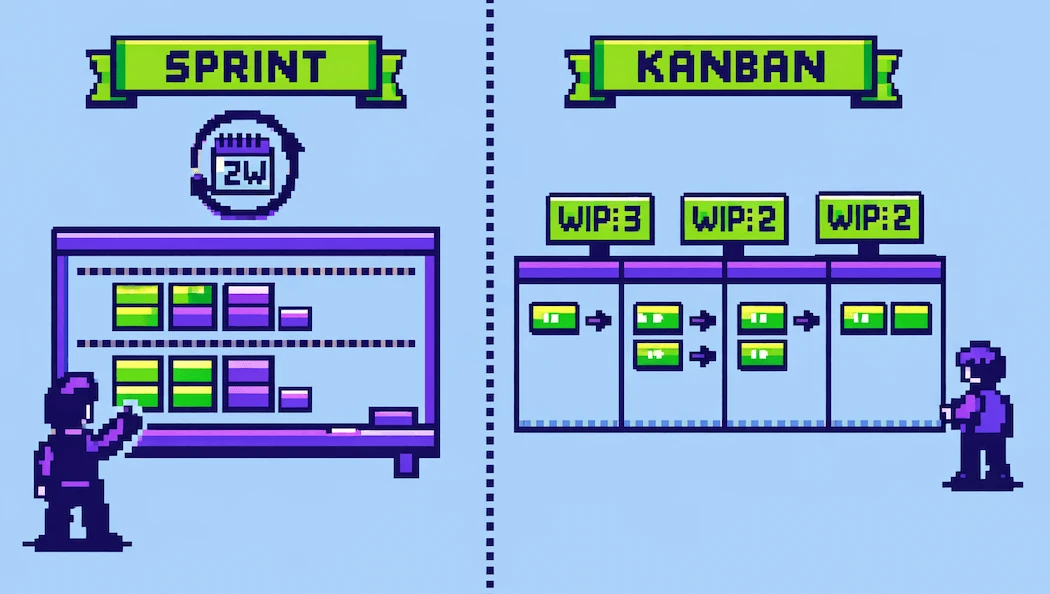
While both frameworks share agile principles, their mechanics differ significantly. Here is a direct comparison:
| Aspect | Scrum | Kanban |
|---|---|---|
| Cadence | Fixed sprints (1-4 weeks) | Continuous flow |
| Roles | Product Owner, Scrum Master, Dev Team | No prescribed roles |
| Planning | Sprint planning at start of each sprint | Continuous, on-demand |
| Changes | No changes during sprint | Changes anytime |
| Metrics | Velocity (story points per sprint) | Lead time, cycle time, throughput |
| WIP Limits | Sprint capacity (implicit) | Explicit per-column limits |
| Board | Resets each sprint | Continuous |
| Best For | Feature development, releases | Support, maintenance, variable work |
"Both require a lot of discipline. People underestimate how hard both frameworks are."
The table makes the differences look clean, but reality is messier. Many teams using Scrum add WIP limits to their sprint boards. Many Kanban teams add regular planning cadences. Both frameworks require a clear definition of done to maintain quality regardless of how work flows through the system.
When to Choose Scrum
Scrum shines in environments where predictability and structure drive success. Consider Scrum when your team fits these scenarios:
Building new products. When you are creating something from scratch, Scrum's sprint cadence provides natural checkpoints. Sprint reviews force regular stakeholder feedback, catching misalignment early. B2B SaaS companies building v1 products benefit enormously from this feedback loop. You learn fast, adjust fast, and avoid building the wrong thing for months.
Quarterly release cycles. Organizations with quarterly roadmap commitments need the predictability Scrum offers. Velocity data from past sprints helps teams forecast what they can deliver, making stakeholder conversations grounded in data rather than gut feeling. When a VP asks "Can we ship this by Q3?", you can answer with historical velocity data instead of optimistic guessing.
Teams that need structure. Junior teams, newly formed cross-functional teams, or teams recovering from a chaotic process benefit from Scrum's guardrails. The prescribed ceremonies create habits. Daily standups build communication patterns. Retrospectives normalize continuous improvement. The structure is not bureaucracy. It is scaffolding that you remove as the team matures.
Fintech and compliance-heavy industries. When you need audit trails, defined approval gates, and predictable delivery windows, Scrum's sprint structure creates natural documentation points. Each sprint review produces a record of what was delivered and approved.
The pattern I see across coaching engagements: Scrum works best when the team has a clear Product Owner who can prioritize ruthlessly and a Scrum Master who actually protects the process. Without both, Scrum degrades into "sprint-shaped waterfall" where teams go through the motions without the mindset.
Effective backlog management is non-negotiable for Scrum. If your backlog is a dumping ground of 500 items with no prioritization, no amount of sprint planning will save you.
When to Choose Kanban
Kanban excels in environments where work arrives unpredictably and flexibility matters more than fixed commitments. Consider Kanban when:
Support and maintenance teams. Customer support engineering teams deal with tickets that arrive unpredictably. Forcing support work into two-week sprints creates artificial constraints. Kanban lets these teams respond to the highest-priority item immediately without waiting for a sprint boundary. I have seen support teams cut their average resolution time by 30% simply by switching from sprint-based to flow-based work management.
DevOps and infrastructure. Operations work is inherently interrupt-driven. Kanban's continuous flow handles production incidents, deployment requests, and infrastructure improvements without the overhead of sprint planning for work that will change by tomorrow. The ability to immediately pull in a critical production issue without "breaking the sprint" removes a constant source of team frustration.
Regulated environments. Teams in healthcare, finance, or government often have compliance workflows that don't map neatly to sprints. Kanban's explicit process policies and flow visualization help these teams maintain compliance while staying agile. Each column on the Kanban board can have explicit policies (e.g., "Items in Review require QA sign-off and compliance check") that serve as built-in governance.
Teams already using another framework. One of Kanban's underappreciated strengths is that you can layer it on top of any existing process. You do not need to abandon what you have. Start by visualizing your current workflow on a board, then gradually add WIP limits and measure flow. This incremental approach reduces the organizational resistance that comes with "we are switching to a new framework."
"Ideas don't come on a quarterly basis. They come throughout the time."
This quote captures why Kanban works for innovation-driven teams too. When discovery and delivery happen simultaneously, the ability to pull in new insights without waiting for a sprint boundary is a real advantage. Teams that run regular refinement sessions alongside Kanban find the right balance between responsiveness and planning.
The Framework Fit Matrix
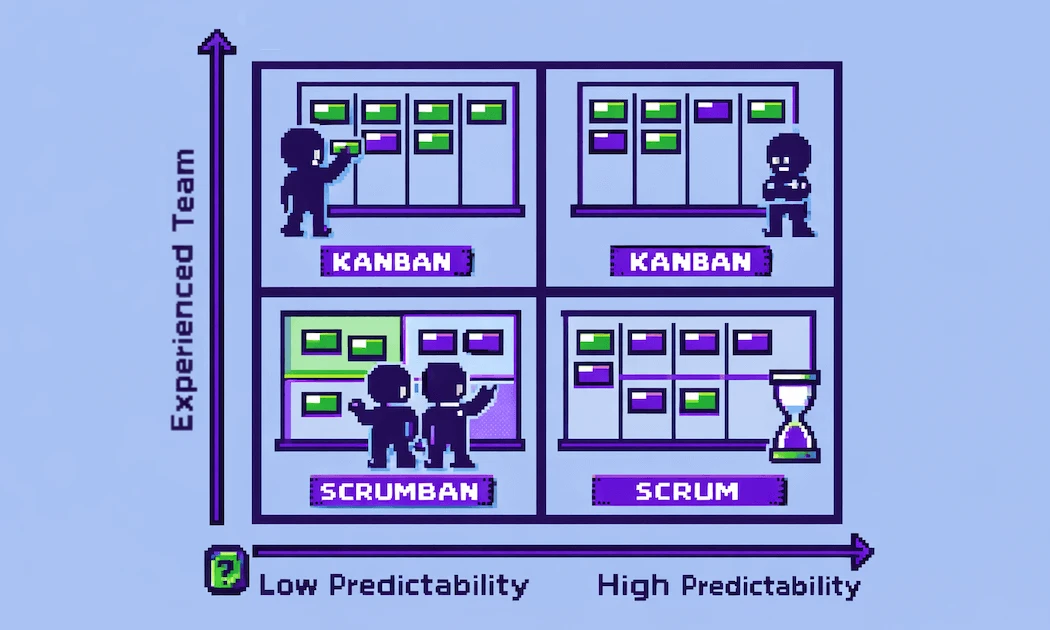
After years of coaching teams through this decision, I developed a simple diagnostic tool. The Framework Fit Matrix uses two dimensions to guide your choice: work predictability and team maturity.
High Predictability
Low Predictability
New Team
Scrum. Structure accelerates learning. Prescribed roles and ceremonies give new teams a playbook to follow while they build collaboration patterns.
Scrumban. Scrum's structure provides guardrails while Kanban's flexibility handles unpredictable work. Use sprints for planning but allow mid-sprint changes with WIP limits.
Experienced Team
Kanban. Experienced teams with predictable work don't need Scrum's overhead. They can self-organize, set their own cadences, and use WIP limits to maintain flow.
Kanban. Experienced teams handle unpredictability well. Flow-based approaches let them respond quickly without the ceremony overhead that would slow them down.
Use this matrix as a starting point, not a prescription. Try your chosen framework for at least three months before evaluating. If it is not working after three months, ask these diagnostic questions before switching:
- Are we actually following the framework, or a watered-down version?
- Do we have the right roles filled (especially Product Owner for Scrum)?
- Is the problem the framework or the team dynamics?
- Are we confusing "uncomfortable discipline" with "wrong framework"?
In my coaching experience, the single biggest predictor of framework success is not the framework itself. It is whether the team has psychological safety to raise problems during retrospectives or flow reviews. A team running Scrum badly will run Kanban badly too if the root cause is fear of speaking up. That is why empowering teams to own their process matters more than which process they choose.
What Scrum and Kanban Look Like Over Time

One thing competitors never cover is how framework usage evolves. Here is what I consistently observe across coaching engagements:
Quarter 1 (Months 1-3): Strict adherence, steep learning curve. Teams follow the textbook. Scrum teams debate story point sizing. Kanban teams struggle with WIP limits. Frustration is normal. This phase tests commitment.
Quarter 4 (Months 10-12): Fluency and adaptation. Ceremonies feel natural for Scrum teams. WIP limits become intuitive for Kanban teams. Teams start making small modifications: Scrum teams might shorten their standups. Kanban teams might add a weekly planning rhythm.
Quarter 8+ (Month 19+): Hybrid maturity. Most teams evolve toward a customized hybrid. According to the State of Agile Report, hybrid agile models account for 50% of implementations. This is not failure. It is maturity. These teams take what works from Scrum (regular retrospectives, sprint reviews) and combine it with what works from Kanban (WIP limits, flow metrics). The result is a process that fits their specific context.
"You can't design culture because culture is how we are, how we behave." (Andrea Tomasini, Agile42)
I coached a fintech team of 8 engineers who started with textbook Scrum. By quarter 6, they had dropped the sprint review in favor of continuous stakeholder demos and added WIP limits to their sprint board. They called it "our process." That is exactly what maturity looks like.
The lesson: do not marry a framework. Marry the principles behind it (transparency, inspection, adaptation) and let your implementation evolve as your team grows.
Making It Work: Handling Framework Resistance
Every framework change encounters resistance. Here are the three patterns I see most often and how to address them:
"We tried Scrum and it didn't work." Nine times out of ten, teams that "failed at Scrum" were doing mini-waterfall with sprint labels. They skipped retrospectives, had no real Product Owner, and treated the sprint as a deadline rather than a learning cycle. The framework did not fail. The implementation did. Before abandoning Scrum, audit whether you actually tried it. Ask your team: Did you have a dedicated Scrum Master? Did you run retrospectives every sprint? Did you protect the sprint from scope changes? If the answer to any of these is "no," you did not try Scrum. You tried something else.
"Kanban is just no process." This misconception comes from confusing "no prescribed roles" with "no discipline." Kanban requires more self-discipline than Scrum because there are fewer external structures enforcing behavior. A Kanban team without WIP limits, without flow metrics, and without explicit policies is not doing Kanban. They are doing chaos with a board on the wall. If your team struggles with self-organization, adding Kanban will not help. Fix the underlying team dynamics first.
"We're too special for frameworks." Every team thinks their situation is unique. And every team is partly right. But frameworks are starting points, not straitjackets. Start with a framework, then customize. Starting from scratch means reinventing solutions to problems that have been solved for 20 years. The teams I coach who insist on building everything custom spend 80% of their process energy on process design and 20% on delivery. That ratio should be inverted.
"Definition of Ready and Done aren't about frameworks. They're sanity checks."
This applies perfectly here. Whether you choose Scrum or Kanban, establish clear criteria for when work is ready to start and when it is truly done. These quality gates apply regardless of framework. Building strong user stories with clear acceptance criteria makes any framework work better.
Conclusion
The framework you choose matters less than the commitment to improve. Scrum gives you structure. Kanban gives you flexibility. Both demand discipline. The best teams pick one, practice it rigorously for three months, then evolve based on what they learn.
"Show me your backlog and I show you your future."
That quote captures the real priority. Whether you organize work in sprints or continuous flow, the quality of what goes into your backlog determines the quality of what comes out. A messy backlog in Scrum produces the same waste as a messy Kanban board.
Here is your action plan: Start with the Framework Fit Matrix above. Assess your team's maturity and the predictability of your work. Pick the matching framework. Run it honestly for one full quarter. Then evaluate using the diagnostic questions. That single cycle will teach you more than any comparison article, including this one.
The decision is important, but it is also reversible. What matters is starting.