Product Coaching: What It Is and Why It Delivers 700% ROI

Studies show, 86% of companies recoup their investment in coaching, with a median ROI of 700%. Yet most product teams have never worked with a product coach, and it's costing them.
In a market where product managers face mounting pressure to deliver results with fewer resources, the difference between teams that thrive and those that struggle often comes down to one factor: access to experienced guidance. Product coaching has emerged as one of the highest-ROI investments a company can make in their product organization.
This article examines what product coaching actually is, the evidence behind it, and how to decide if it fits your team. Founders wondering if coaching could shorten their path to product-market fit, and product leaders considering how to develop their team, will both find data-backed material to inform the decision.
What Is Product Coaching?
A product coach is a specialized practitioner who helps product teams and individual product managers develop their capabilities, overcome obstacles, and achieve measurable outcomes. Unlike consultants who deliver solutions, coaches guide teams to discover answers themselves, creating lasting skill development rather than temporary fixes.
The role differs fundamentally from other product leadership positions. Where a CPO or VP of Product focuses on strategy and execution, a product coach focuses on capability building. Where an Agile coach optimizes team processes and ceremonies, a product coach develops product thinking and decision-making skills.
In order to be able to coach, you need to have had some successes and some fails.
This insight captures something essential about effective product coaching: it requires battle-tested experience. The best product coaches have navigated the same challenges their clients face, failed launches, difficult stakeholders, pivots, scaling pains, and can draw on those experiences to accelerate their clients' growth.
Product Coach vs. Agile Coach vs. Product Lead
Understanding these three roles is essential for building effective product teams:
- Agile Coach: Focuses on team dynamics, processes, and Agile methodology adoption. Their domain is how teams work together, not what they build.
- Product Coach: Focuses on developing product managers and product teams. Their domain is helping people "build the right things" and "get things right."
- Product Lead: Focuses on product strategy and roadmap execution. Their domain is aligning product decisions with business objectives.
The most successful product organizations run all three roles in coordination. However, product coaching often fills a critical gap that neither Agile coaching nor product leadership can address: systematic capability development of product people.
The Evidence: Why Product Coaching Works
The coaching industry has grown to over $6.25 billion globally, driven by compelling evidence of its effectiveness. For product teams specifically, the data is striking.

The ROI of Professional Coaching
Research from the International Coaching Federation (ICF) and PwC reveals consistent patterns across industries:
- 700% median ROI: Companies typically receive seven times their investment in coaching back in value.
- 86% recoup investment: The vast majority of organizations see positive returns from coaching programs.
- 19% see 50x+ returns: Almost one-fifth of companies reported ROI of at least 5,000%.
Impact on Leadership and Team Performance
Beyond financial returns, coaching drives measurable improvements in the capabilities that matter most for product teams:
- 80% improved self-confidence: Coaching clients report stronger conviction in their decision-making.
- 73% improved relationships: Better stakeholder and team dynamics.
- 72% improved communication: Clearer, more effective interactions across the organization.
- 67% improved work-life balance: More sustainable management of the intense demands of the role.
These numbers explain why organizations from startups to enterprises increasingly view product coaching not as an optional development perk, but as a strategic investment in their product capability.
What Product Coaches Actually Do
The work of a product coach spans four distinct methods, each serving different needs. Understanding this distribution helps teams set appropriate expectations.
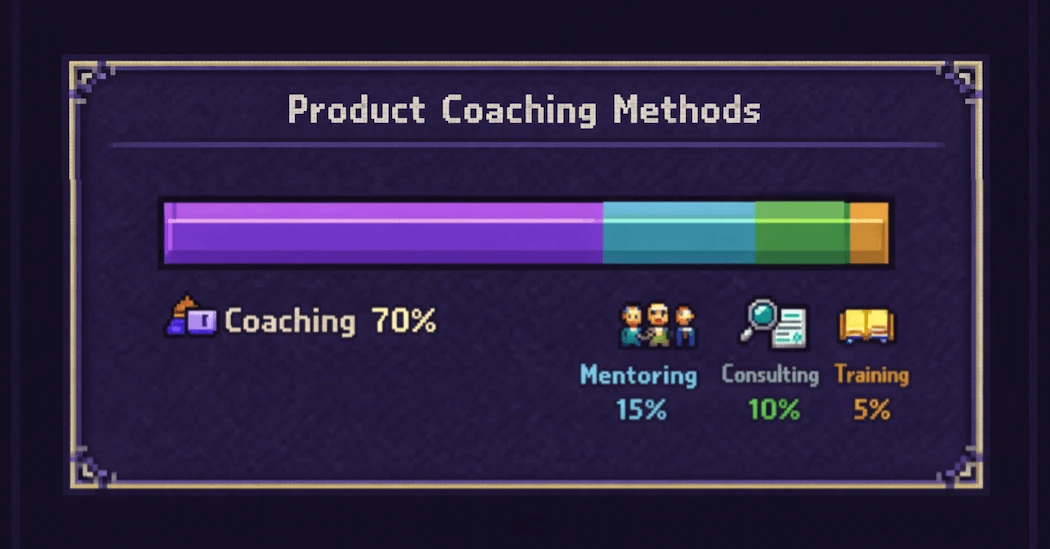
Coaching (70%)
The majority of a product coach's work involves pure coaching: asking powerful questions that help product people discover answers they already possess but cannot access on their own.
Product managers often know the right path forward but are blocked by stress, conflicting priorities, organizational politics, or lack of clarity. A skilled coach helps them cut through the noise and find their own solutions, which creates much deeper learning than simply being told what to do.
This approach connects to a fundamental truth about product management skill development:
Product management is like learning language - being dumped in the environment is the fastest way to learn.
Coaching accelerates this immersive learning by providing a safe space to process experiences, challenge assumptions, and develop pattern recognition faster than trial-and-error alone would allow.
Mentoring (15%)
Where coaching asks questions, mentoring shares experience. A product coach draws on their own career, the wins and losses, the patterns they've observed across companies and industries, to help clients navigate specific situations. These key product learnings from real experience are what make mentoring so valuable.
As William Campbell described in The Trillion Dollar Coach: mentoring is when two practitioners come together and one teaches the other certain practices. It's direct knowledge transfer from someone who has done the work.
Consulting (10%)
Sometimes teams need expert analysis and recommendations rather than guided discovery. A product coach shifts into consulting mode when clients face challenges requiring specialized knowledge, organizational design, process implementation, or technical product decisions.
For example, an eCommerce company restructuring around feature teams might need consulting on domain boundaries and team topologies, drawing on the coach's experience with similar transformations at other organizations.
Training (5%)
When teams lack foundational knowledge, coaching becomes training. A product coach identifies knowledge gaps and delivers structured education on product management best practices, frameworks, and methodologies.
This typically covers areas like:
- Product Discovery techniques
- Prioritization frameworks
- Stakeholder Management
- Product Strategy development
- User research methods
- Metrics and measurement
Types of Product Coaching
Product coaching takes different forms depending on the client's situation and goals. The most effective coaches adapt their approach to match specific needs.
Discovery Coaching
Focused on helping teams validate ideas and understand user needs before committing development resources. Discovery coaches guide teams through customer interviews, experiment design, and evidence-based decision making.
Leadership Coaching
Targeted at product leaders, Senior PMs, Group PMs, Directors, VPs, who need to develop strategic thinking, stakeholder management, and team leadership skills. This coaching helps practitioners transition from individual contributor excellence to organizational impact.
Transformation Coaching
Supports organizations undergoing significant change: adopting product-led approaches, restructuring product teams, or shifting from project to product mindsets. Transformation coaches work with leadership to design and implement organizational change.
Career Coaching
Helps product professionals navigate career decisions: transitioning into product management, moving between companies or industries, or advancing to senior roles. Career coaches provide guidance on positioning, skill development, and opportunity evaluation.
For those considering breaking into product management, working with a career-focused product coach can significantly accelerate the transition by providing structured guidance and accountability.
When Your Team Needs a Product Coach
Not every product team needs external coaching. But certain situations signal that coaching could deliver significant value.
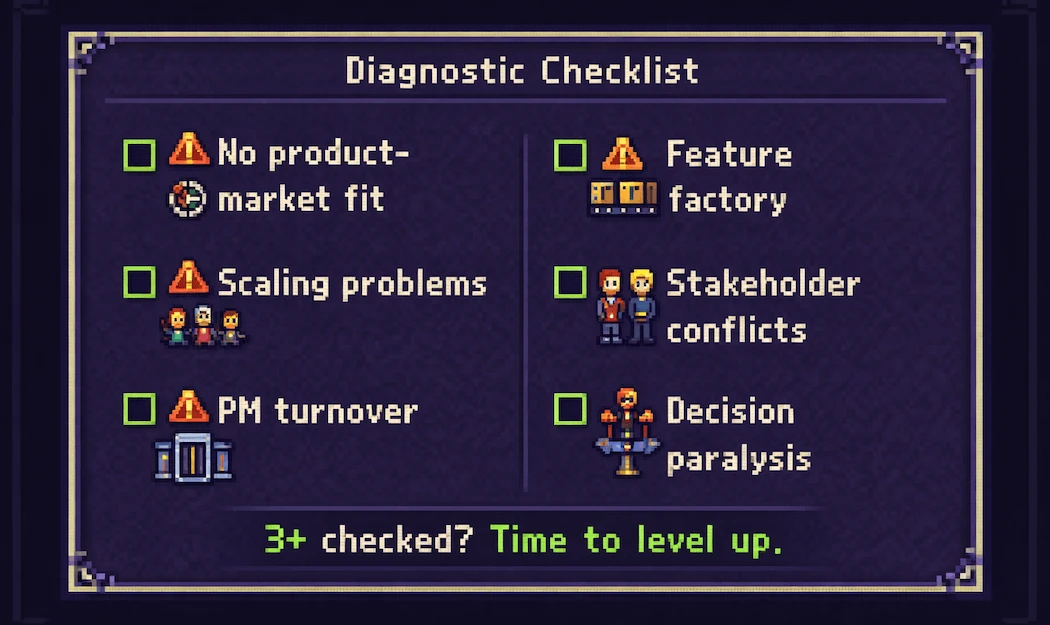
Warning Signs You Need Coaching
- Struggling to find product-market fit: Repeated pivots without traction suggest capability gaps in discovery or validation.
- Scaling challenges: What worked with one product team breaks down as you grow.
- High PM turnover: Product managers leaving often indicates development and support gaps.
- Feature factory syndrome: Building features without clear impact on business outcomes.
- Stakeholder conflicts: Constant battles with engineering, sales, or executive leadership.
- Decision paralysis: Teams struggle to prioritize or commit to direction.
Product Coaching for Startups
Startups can launch without a product manager, but scaling requires product discipline. A product coach helps founders develop proper problem definition, validation approaches, and MVP thinking from day one. For the full guide on how product coaching helps startups find product-market fit faster, see my dedicated article on the topic.
With a clear product vision and strategy, engineering teams can build with purpose rather than reacting to the latest stakeholder request. The investment in coaching early often prevents costly pivots later.
Product Coaching for Scaleups
The processes that worked with 5 people rarely survive to 50. Scaleups face unique challenges: maintaining product quality while growing teams, preserving decision speed while adding coordination, developing new leaders while shipping product.
Product coaches help scaleups design organizational structures, career development paths, and operating models that enable continued growth without sacrificing product excellence.
Product Coaching for Culture
The best product cultures share common traits: customer obsession, evidence-based decisions, continuous learning, and psychological safety. These cultures don't emerge by accident, they're cultivated deliberately.
A product coach helps establish and reinforce the behaviors and mindsets that define strong product culture:
- More job satisfaction
- Stronger cross-functional relationships
- Better team collaboration
- Improved productivity
- Higher quality outcomes
How to Become a Product Coach
For experienced product managers considering the coaching path, the transition requires deliberate skill development beyond product expertise.
Experience Requirements
Effective product coaches typically bring:
- 8+ years of product management experience across multiple companies, industries, or product stages
- Track record of measurable impact: Successful launches, revenue growth, team development
- Diverse context exposure: B2B and B2C, startup and enterprise, different organizational models
- Leadership experience: Managing or mentoring other product managers
The depth of experience matters because coaching effectiveness depends on pattern recognition, seeing connections between a client's situation and similar challenges you've navigated before.
Skills Beyond Product Management
Technical product skills are necessary but not sufficient. Great product coaches also develop:
- Active listening: Hearing what's said and unsaid, without rushing to solutions
- Powerful questioning: Asking questions that create insight rather than demonstrate knowledge
- Emotional intelligence: Reading client states and adapting approach accordingly
- Facilitation: Guiding groups through difficult conversations and decisions
- Business acumen: Understanding organizational dynamics and business models
Many product coaches pursue formal coaching certifications (ICF credentials, for example) to develop these capabilities systematically.
What Product Coaches Earn
Product coaching compensation varies significantly based on experience, client type, and engagement model:
- In-house product coaches: $97,000 - $159,000 annually, depending on company size and location
- Independent consultants: $200 - $500+ per hour for individual coaching; $1,500 - $5,000+ daily for organizational engagements
- Coaching agencies: Senior coaches at established firms can earn $150,000 - $250,000+
The path to higher compensation typically runs through building a reputation for results, specializing in high-value niches, and developing long-term client relationships.
AI is reshaping product management, and coaching is no exception:
AI will not replace product managers, but product managers who master AI will replace those who don't.
Product coaches who help clients navigate AI adoption, both as a tool and as a factor in product strategy, will find growing demand for their expertise.
How to Choose the Right Product Coach
Selecting a product coach is a significant decision. The right match accelerates growth; the wrong one wastes time and money.
What to Look For
- Relevant experience: Have they faced challenges similar to yours? A startup coach may not suit enterprise transformation.
- Clear methodology: Can they explain their approach? Vague promises of "support" signal lack of structure.
- Track record: Can they share specific outcomes from past engagements? Look for measurable results.
- Chemistry: Coaching requires trust and openness. The relationship should feel collaborative, not transactional.
- Continued learning: Do they stay current with product practice? The field evolves rapidly.
Red Flags to Avoid
- All theory, no practice: Coaches who've never shipped product may struggle with real-world nuance.
- One-size-fits-all: Cookie-cutter programs ignore the context that makes coaching valuable.
- Guarantee of outcomes: No coach can promise specific results, success depends on client commitment.
- Focus on tools over thinking: Frameworks matter less than developing judgment.
Questions to Ask
Before engaging a product coach, explore:
- What's your experience with [specific challenge you face]?
- How do you measure coaching success?
- What does a typical engagement look like?
- How do you adapt to different learning styles?
- Can you share a case study from a similar situation?
Understanding what makes a great product manager can help you evaluate whether a potential coach embodies those qualities themselves.
Start Building Better Products
The evidence is clear: product coaching works. With 86% of companies seeing positive returns and a median ROI of 700%, the question isn't whether coaching adds value, it's whether your team is ready to capture that value.
The best product coaches don't just solve immediate problems. They build lasting capabilities that compound over time, creating product organizations that consistently deliver customer value and business results.
If your team is struggling with product-market fit, scaling challenges, or building product culture, coaching might be the highest-leverage investment you can make. The key is finding a coach whose experience matches your context and whose approach resonates with how your team learns.

Need A Product Coach?
I help founders and product leads fix what's actually broken, hands-on. See how I can help.