Product Coaching for Startups: From 0 to Product-Market Fit

TL;DR: Product Coaching for Startups
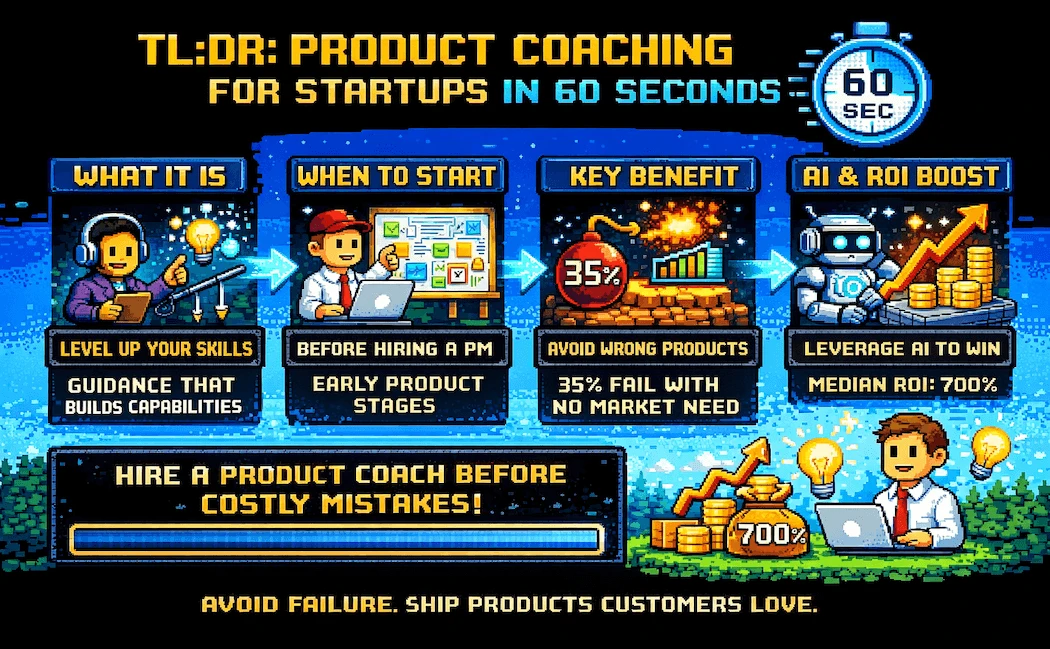
Product coaching for startups is a sparring partner in your leadership meetings who builds your product thinking, so you validate before you build.
- When: Before you hire a product manager, or with a team of one to three PMs.
- The reason: 35 % of startups fail because there was no market need, and a coach makes you check that first.
- With AI: A coach shows founders how to use AI for faster discovery, prototyping and decisions.
- The return: 86 % of companies recoup their coaching investment, with a median return of 700 %.
- The offer: What the engagement looks like and whether it fits your startup is at the end of the article.
Most startups fail because they build the wrong product, not because they can't build. Product coaching helps founders escape this trap by developing the skills and frameworks to validate ideas, prioritize ruthlessly, and ship what customers actually want.
You're a founder. You have a vision, maybe funding, definitely pressure. But you don't have a product manager, and you're not sure you need one yet. What you DO need is someone who can help you think like one. That is exactly what my product coaching for startups is: a sparring partner who sits in your leadership meetings and helps you make the calls.
This article maps the startup founder's journey from idea to product-market fit, showing exactly where product coaching accelerates each stage.
What Is Product Coaching for Startups?
Product coaching is external guidance focused on capability building, not just delivery. Unlike hiring a product manager who owns your roadmap, a coach develops YOUR ability to make better product decisions.
The distinction matters for startups. When you hire a PM, you're buying execution. When you work with a coach, you're investing in your own growth as a product thinker. This means the value compounds: you keep the skills long after the engagement ends.
"In order to be able to coach, you need to have had some successes and some fails."
This insight captures something essential about effective product coaching: it requires battle-tested experience. The best product coaches have navigated the same challenges you face: failed launches, difficult pivots, scaling pains. They can help you avoid the expensive mistakes they've made.
Coaching vs. Consulting vs. Hiring
Understanding the differences helps you choose the right support:
- Consulting: Someone does the work for you. They analyze, recommend, and deliver. When they leave, so does the capability.
- Hiring a PM: Someone joins your team to own product. Great for scaling, but premature for early-stage startups still finding fit.
- Coaching: Someone teaches you to do the work yourself. The skills stay with you and your founding team forever.
For startups pre-product-market fit, coaching typically delivers the highest ROI because founders need to develop product intuition, not delegate it.
The Startup Product Journey: Where Coaching Fits
Every startup moves through predictable stages. Understanding where you are helps you know what kind of support you need.
| Stage | Focus | Coaching Value |
|---|---|---|
| 0→1: Idea Validation | Problem-solution fit | Prevent building the wrong thing |
| 1→10: MVP to PMF | Product-market fit | Accelerate learning cycles |
| 10→100: Early Traction | Scaling product | Prepare for first PM hire |
| 100+: Growth | Team building | Develop product culture |
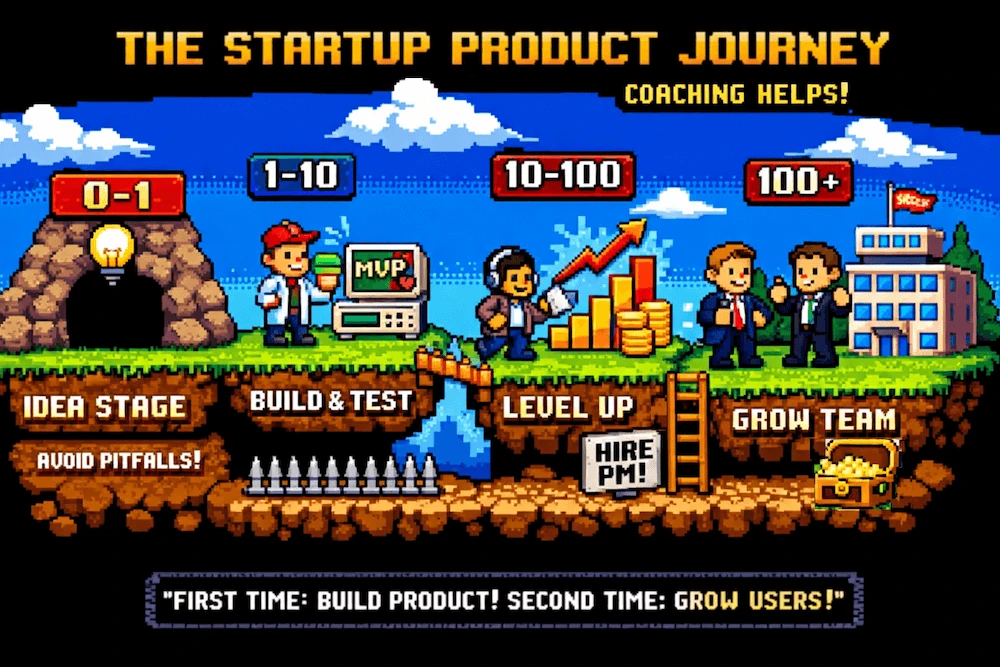
"First time founders focus on product, second time founders focus on distribution." (Monica Lent)
This quote from the Product Bakery Podcast reveals a common pattern: first-time founders often over-invest in building and under-invest in validating. A product coach helps you balance both from the start.
Stage 0→1: Idea Validation
Most startups spend months building features nobody wants. A coach helps you define the problem worth solving before writing code. This stage is about developing a clear product vision that guides all subsequent decisions.
Stage 1→10: MVP to PMF
The most critical and uncertain phase. You're searching for product-market fit, that magical moment when customers pull the product from you. A coach helps you design experiments, interpret signals, and decide when to pivot vs. persist.
Stage 10→100: Early Traction
You've found something that works. Now you need to scale it without breaking what made it work. This is when coaching shifts toward preparing you to hire your first PM and building product strategy that can survive growth.
Stage 100+: Growth
At this stage, you're building a product organization, not just a product. Coaching focuses on culture, team development, and empowering teams to make decisions without founder bottlenecks.
Finding Product-Market Fit with a Coach
The PMF myth says "you'll know it when you see it." The reality is messier. Many founders think they have PMF when they don't, or miss the signals when they do. A coach brings objectivity and pattern recognition to this critical evaluation.
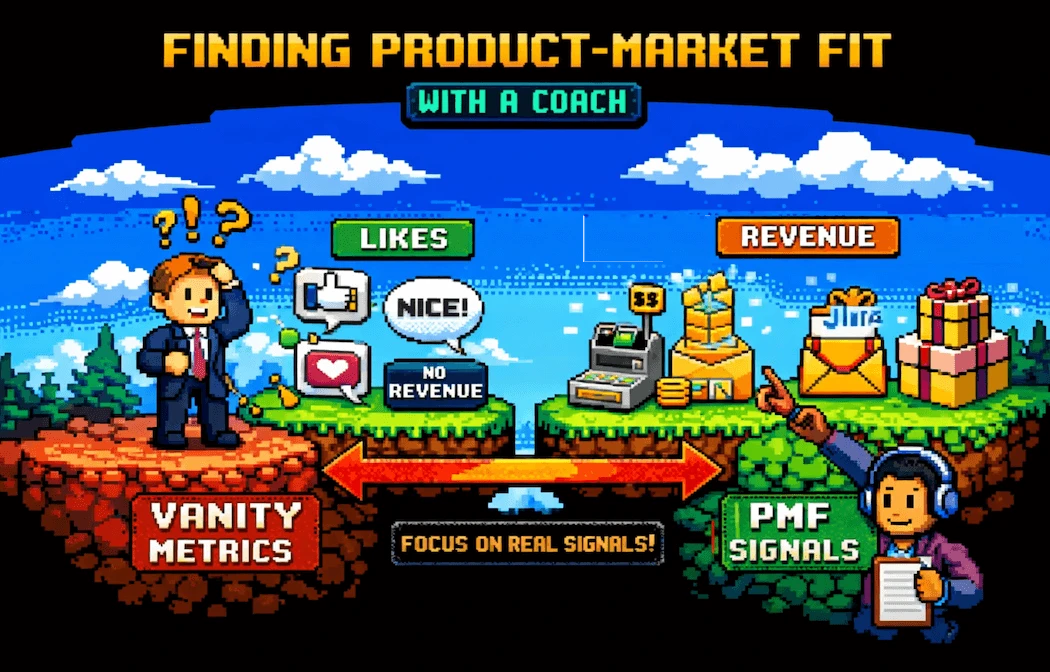
"An email address is a valuable commodity. That in itself is great validation." (Jim Semick, ProductPlan)
This insight from Jim Semick cuts through the noise about what validation actually looks like. A coach helps you distinguish real signals from vanity metrics.
The Problem with "You'll Know"
According to Harvard research, 75% of VC-backed companies never return cash to investors. CB Insights reports that 35% of startups fail due to "no market need." These aren't stupid founders. They're smart people who misread the signals.
A product coach provides the outside perspective founders lack. When you're deep in building, it's hard to see whether customers genuinely need your product or are just being polite.
"An MVP is the smallest thing to learn the next most important thing." (Josh Seiden)
Josh Seiden's definition from Lean UX reframes how startups should think about building. Your MVP isn't a minimal product. It's a minimal experiment. A coach helps you design experiments that actually teach you something.
How Coaches Help You Find PMF
- Structured validation: Coaches bring frameworks for testing assumptions systematically, not randomly.
- Bias interruption: Founders naturally see what they want to see. Coaches ask uncomfortable questions.
- Signal interpretation: What does 40% "very disappointed" actually mean? Coaches help you read the data.
- Pivot decisions: When should you persist and when should you change direction? Coaches provide calibrated judgment.
The goal of product discovery isn't to validate your idea. It's to learn whether your idea is worth building. A coach helps you stay honest with yourself.
User Research on a Bootstrap Budget
Startups often skip research because they think they can't afford it. This is backwards: you can't afford NOT to research. Building the wrong product is infinitely more expensive than talking to users first.
"Customer development focuses on solutions that solve customer problems AND can be sustainably built." (Cindy Alvarez, GitHub)
Cindy Alvarez's insight from the Product Bakery Podcast captures the dual mandate: your solution must be both desirable AND feasible. A coach helps you hold both constraints.
The "5 User Interview" Rule
You don't need hundreds of interviews to learn something valuable. Research shows that five well-conducted interviews reveal 85% of usability issues. A coach helps you make each conversation count.
"Five to seven users per segment. That's the magic number for usability testing." (Nikki Anderson, Zalando)
Nikki Anderson's guidance gives you a concrete target. A coach helps you recruit the right users, ask the right questions, and interpret what you hear.
Guerrilla Research Techniques
Startups can't afford dedicated research teams. But you can:
- Intercept users: Find them where they already are: LinkedIn, Reddit, Twitter, industry events.
- Tap your existing customers: Early adopters often love providing feedback.
- Use your network: Friends-of-friends who match your target profile.
- Offer value exchange: Early access, consulting on their problems, small gifts.
A product coach helps you design research programs that fit your constraints. The investment in learning user research methods pays dividends throughout your company's life.
Building Your First Product Team
Every startup eventually needs to hire. The question is when and who. A coach helps you navigate these decisions with frameworks rather than gut feel.
Founder as PM: When It Works
In the early stages, founders ARE the product managers. This is good: you need founder intuition driving product decisions. A coach helps you formalize what you're doing naturally so you can eventually hand it off.
"Product management is like learning a language. Being dumped in the environment is the fastest way to learn." (Shaun Russell)
Shaun Russell's metaphor explains why coaching works for founders: you're already in the environment. A coach helps you extract maximum learning from your immersion.
When to Hire Your First PM
Traditional wisdom said hire a PM after 6-8 engineers. AI has compressed this timeline, so many startups now hire after 4-5. But the real answer depends on:
- Your bandwidth: Are you dropping product balls because you're fundraising, selling, or managing?
- Your skill gaps: Does the product need capabilities you don't have?
- Your stage: Have you found PMF? Hiring a PM before PMF often backfires.
A coach helps you assess readiness honestly. Premature hiring wastes money; late hiring wastes opportunity.
The Player-Coach Model
Your first PM should be a "player-coach": someone who can do the work themselves while also building process. This is different from a pure manager who coordinates others.
A product coach can help you:
- Define the role correctly for your stage
- Evaluate candidates for the right skills
- Onboard effectively so they succeed
- Avoid common mistakes like sprint planning failures that derail new teams
AI as a Force Multiplier for Startups
AI has fundamentally changed what small teams can accomplish. A modern product coach helps founders use these tools well.
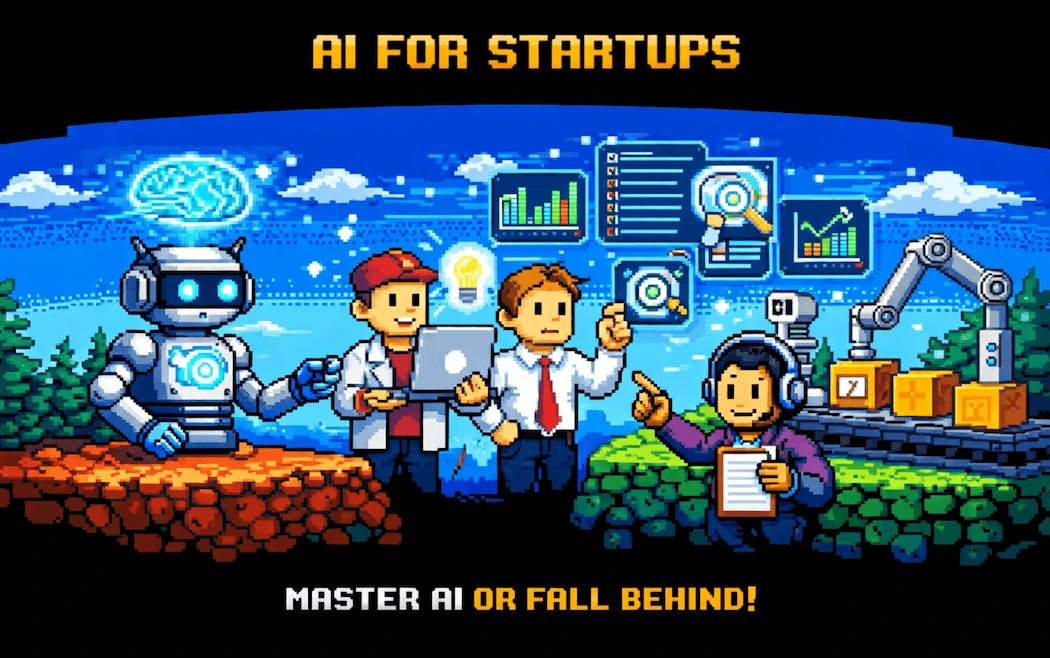
"AI will not replace product managers, but product managers who master AI will replace those who don't." Ofir Natan, Chief Product Officer and AI Consultant
This quote from the Product Bakery Podcast captures the new reality. AI isn't optional. It's a competitive necessity. Startups that master AI move faster than those that don't.
AI-Powered Prototyping: The New Standard
This isn't a nice-to-have anymore. AI-powered development is the new standard for startup product teams. Those who don't adapt will be outpaced by competitors who do.
Claude Code and Cursor have changed how prototypes get built. A product manager or designer can now describe a feature in plain language and generate working frontend code. The engineering team shifts from building to reviewing. Instead of waiting two weeks for a prototype, you have something testable in hours. This changes the entire discovery loop.
No-code backends with n8n and Make.com take this further. Product teams can now build functional automations, connect APIs, and create working backends without engineering dependencies. Need to test whether users will actually complete a multi-step onboarding flow? Build it in n8n, run the experiment, get real data. Then decide if it's worth engineering time to build properly.
The result: product teams become 10x more independent. They can test ideas before involving engineering. They can validate assumptions with working software, not just mockups. This speed advantage compounds over time.
AI for Discovery and Decision-Making
Beyond building, AI transforms how you learn:
- Interview synthesis: Tools like Otter.ai or Grain transcribe and summarize customer calls. What took hours of note review now takes minutes.
- Competitive intelligence: AI can monitor competitor changes, review sentiment, and surface market signals automatically.
- Data analysis: Feed your metrics into Claude or ChatGPT. Ask questions in plain language. Get insights without building dashboards first.
"AI will not replace you, but a person using AI might."
Your competitors are using these tools. If you're still doing discovery and prototyping the old way, you're already behind.
The Coach's Role in AI Adoption
A product coach helps founders navigate this shift:
- Tool selection: Which AI tools deliver real value vs. create distraction? The set of tools changes monthly.
- Workflow redesign: How do you restructure PM-engineering collaboration when PMs can prototype?
- Quality judgment: AI outputs need human review. When do you trust the machine? When do you override?
- Team dynamics: How do you help engineers embrace AI assistance rather than feeling threatened?
The goal isn't to replace anyone. It's to make your entire product team faster, more autonomous, and more capable of testing ideas before committing engineering resources.
How to Work with a Product Coach
If you've decided coaching is right for your startup, here's how to make the engagement successful.
Engagement Models
- Hourly: Best for specific challenges or occasional guidance. Typically $200-500/hour.
- Retainer: Ongoing relationship with regular sessions. Usually monthly or quarterly commitments.
- Project-based: Focused on a specific outcome like defining your MVP or preparing for PM hire.
What to Expect in the First 90 Days
A good coaching engagement typically follows this arc:
- Days 1-30: Assessment and goal-setting. Where are you now? Where do you want to be?
- Days 31-60: Skill building and practice. Working on specific capabilities you've identified.
- Days 61-90: Integration and independence. Applying what you've learned without hand-holding.
Measuring Coaching ROI
Research from ICF and PwC shows that 86% of companies recoup their coaching investment, with a median ROI of 700%. For startups, track:
- Decision speed: Are you making product decisions faster?
- Validation quality: Are your experiments generating clearer signals?
- Pivot confidence: Do you know when to persist vs. change?
- Team readiness: Are you prepared to scale the product function?
Red Flags to Avoid
Not all coaches are created equal. Watch out for:
- All theory, no practice: Coaches who've never shipped product struggle with real-world nuance.
- Guaranteed outcomes: No coach can promise specific results. Success depends on your commitment.
- Cookie-cutter programs: Your startup is unique. The coaching should be too.
- Tool worship: Frameworks matter less than developing judgment.
Is Product Coaching Right for Your Startup?
Product coaching isn't for everyone. Here's how to decide.
Signs Coaching Would Help
- You're struggling to find product-market fit despite multiple attempts
- You're building features but not seeing traction
- You're making product decisions based on gut feel, not evidence
- You're preparing to hire your first PM but don't know what to look for
- You're scaling the team and need to formalize product practices
Signs You're Not Ready
- You haven't built anything yet. You need to start, not optimize
- You're not willing to challenge your assumptions
- You're looking for someone to make decisions for you
- You're in crisis mode with no bandwidth for reflection
Next Steps
If coaching sounds right for your startup:
- Define your goals: What specific outcomes do you want?
- Evaluate your stage: Where are you in the 0→1→10→100 journey?
- Find the right fit: Look for coaches with experience at your stage and domain.
- Start the conversation: Most coaches offer discovery calls to assess fit.
The best time to work with a product coach is before you need one. The second-best time is now.