Product Strategy: A Practical Framework for Product Managers
TL;DR: Product Strategy
- Definition: Product strategy is a high-level plan that connects your product vision to execution by defining WHO you serve, WHAT problems you solve, and HOW you win
- Not a document: Strategy is a decision-making framework, not a slide deck
- Key elements: Vision alignment, market positioning, customer focus, competitive differentiation, and measurable goals
- Timeframe: 1-2 years maximum, anything longer becomes fiction
- Success metric: Does your team know what to say NO to?
"There's nothing so useless as doing efficiently that which should not be done at all." Rich Mironov, 30-year product veteran
That quote captures why product strategy matters. Without it, teams ship features that don't move the needle. They optimize the wrong things. They build efficiently but ineffectively.
Product strategy is the bridge between your ambitious product vision and daily execution. It answers the question every PM dreads from stakeholders: "Why are we building THIS instead of THAT?"
In this guide, you'll learn what product strategy actually is (spoiler: it's not a document), how to create one that drives real decisions, and the frameworks used by top product leaders.
What Is Product Strategy?
Product strategy is a high-level plan that defines how your product will achieve its vision by making deliberate choices about:
- Who you serve (and who you don't)
- What problems you solve (and which you ignore)
- How you differentiate from alternatives
- Why customers will choose you
"Strategy by definition is choosing what NOT to do." Christian Idiodi, SVPG Partner
This is the part most teams get wrong. They think strategy means having a plan. But a strategy that tries to do everything is no strategy at all. The power of product strategy comes from focus, from the courage to say no to good ideas so you can say yes to great ones.
A product strategy should always be related to a product vision. There's a quote from Dave Ramsey that perfectly captures this relationship:
"A goal without a plan is just a dream."
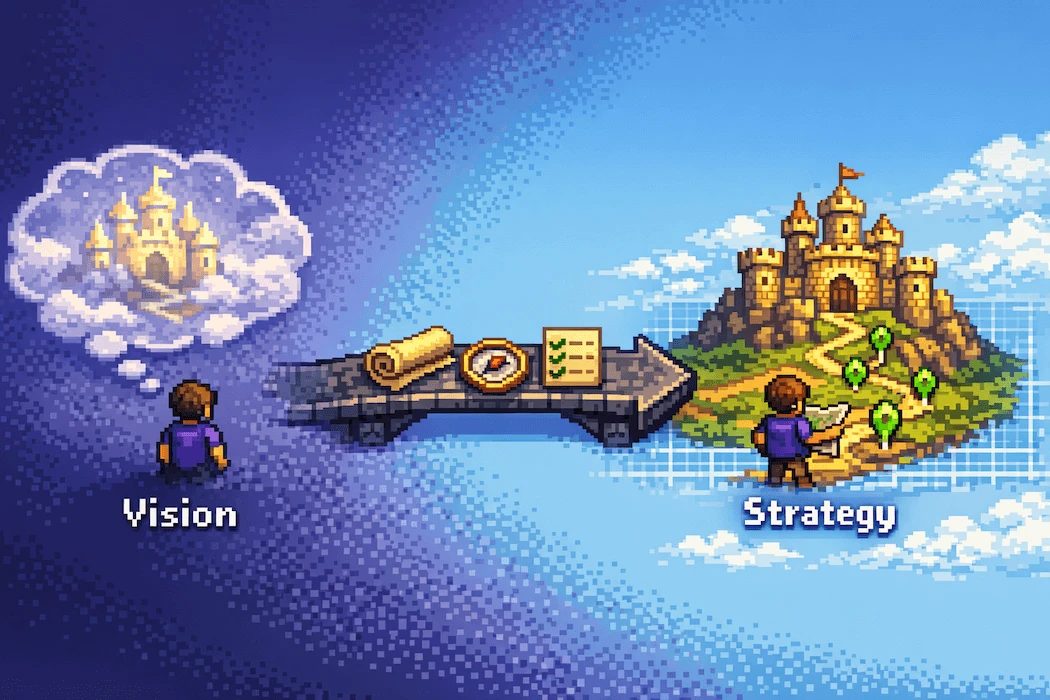
Everything starts with a dream (the vision). To make it come true, you need a plan (the strategy).
Strategy vs. Vision vs. Roadmap
These three concepts work together but serve different purposes:
| Concept | Question It Answers | Timeframe | Changes |
|---|---|---|---|
| Vision | Where are we going? | 3-10 years | Rarely |
| Strategy | How will we get there? | 1-2 years | Annually |
| Roadmap | What are we building next? | 3-12 months | Quarterly |
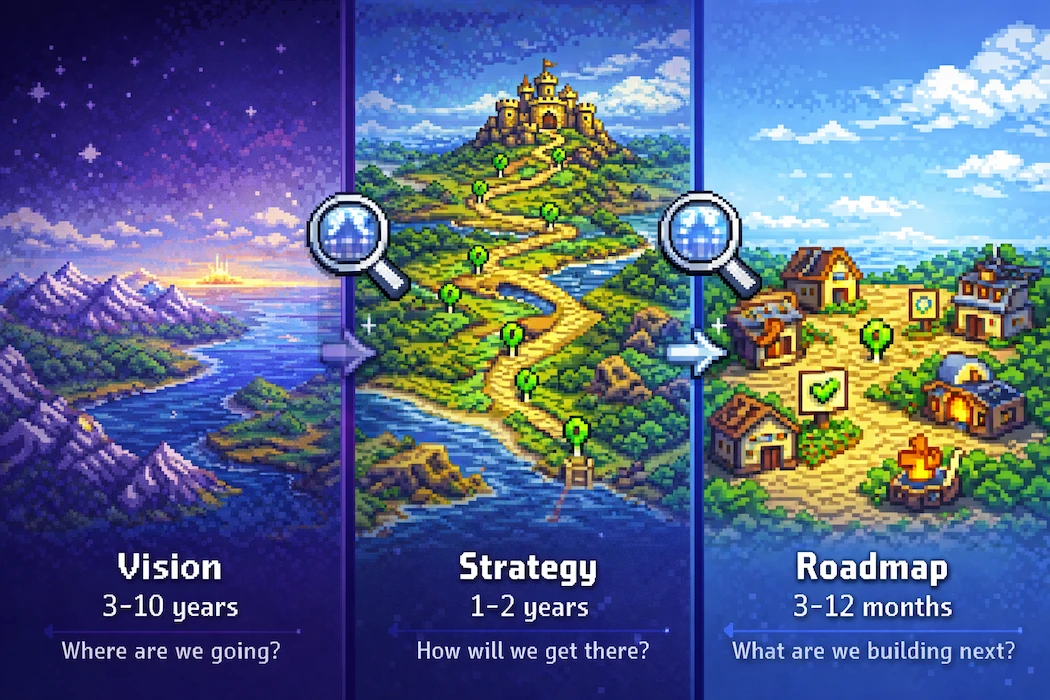
Your product vision is the destination. Your strategy is the route you'll take. Your roadmap is the next few turns.
A common mistake: treating the roadmap AS the strategy. If your "strategy" is just a list of features you plan to build, you don't have a strategy, you have a to-do list.
Why Product Strategy Matters
Here's a sobering reality: Everest Group research found that 73% of enterprises failed to provide any business value from their digital transformation efforts. One key reason? Lack of a clear strategy.
Without strategy, teams build features that don't connect to outcomes. They optimize the wrong things. They ship efficiently but ineffectively. A strong product strategy solves this by:
- Aligning teams around shared priorities
- Enabling faster decisions because the framework exists
- Reducing waste by focusing resources on what matters (this principle sits at the core of lean methodology)
- Creating accountability with measurable goals
- Empowering "no" with a legitimate reason
"Strategy is a deployable decision-making framework." Jill Lin, Bain & Company
When your strategy is clear, your team doesn't need to escalate every decision. They can ask: "Does this align with our strategy?" If yes, proceed. If no, deprioritize.
Key Elements a Product Strategy Needs
The product strategy needs to cover three core areas:
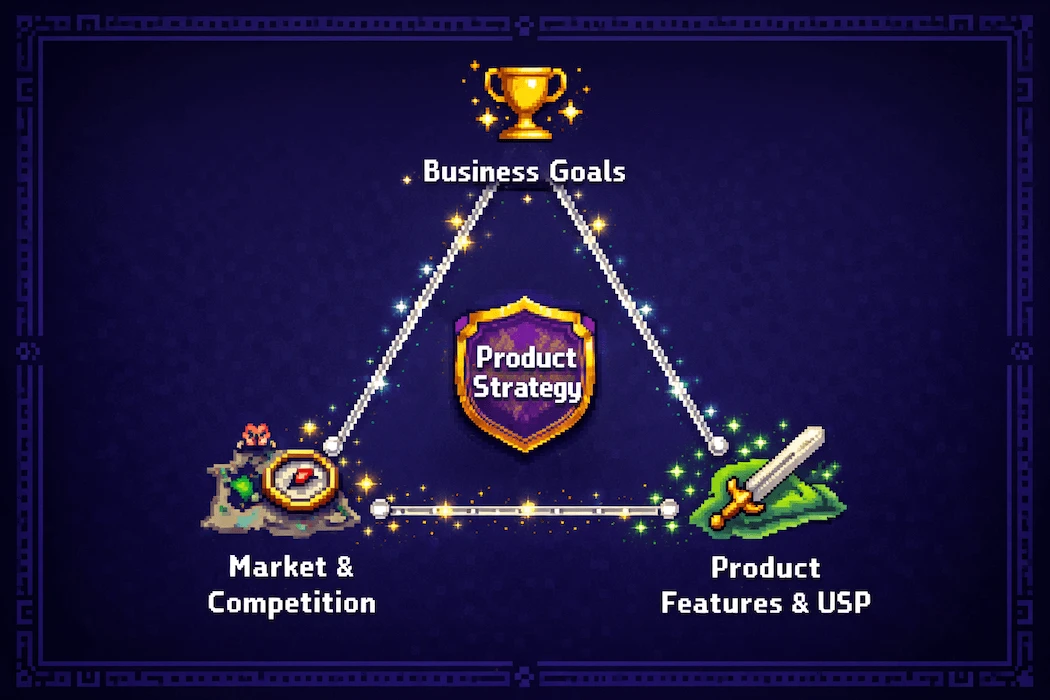
- Business/Financial Goals
- Market & Competition
- Product Features & USP
Each of these needs to be broken down further. Let's look at each element:
1. Product Vision as the Foundation
Your strategy must connect to your product vision. The vision describes the future state your team wants to achieve. The strategy explains HOW you'll get there in the next 1-2 years.
Start every strategy document with the vision. This frames everything that follows and helps stakeholders understand the "why" behind your choices.
Keep in mind that a product vision should be a short and clear sentence, not a long piece of text.
2. Business Goals for Strategic Direction
Every business has its goals. Without goals and priorities, companies aren't able to survive. Product goals are always coupled with business goals.
Let's look at a simplified example: Imagine we're a bakery in New York that only bakes whole-grain bread. Product-wise, we have many options, other bread types, sandwiches, cakes. But the main business goal is to "conquer" the whole-grain bread market and become the best in that niche. Find your niche, and own it.
Having such a clear business focus needs to be highlighted at the beginning of a product strategy. It's important for Product Managers to align with stakeholders and leadership from the outset.
3. Market Analysis
To truly understand what the product is and where you want to be, you must look at the market. Every product strategy needs clear information about:
- Market size and trends, Is this market growing or shrinking?
- Competitive landscape, Who else solves this problem?
- Your position, Are you the leader, challenger, or niche player?
- Customer segments, Who values your differentiation most?
Don't just analyze competitors' features. Understand their strategies. A feature comparison tells you what they built. Strategic analysis tells you what they'll build next, and whether you've truly achieved product-market fit in your chosen segment. Product marketing plays a critical role here, translating your market position into messaging that resonates with target customers. When evaluating strategic opportunities or assessing new markets, product due diligence provides a structured framework for validating these assumptions.
4. Customer Focus (Personas)
Your personas should come from thorough product discovery research. Techniques like user story mapping can help visualize customer journeys and validate scope. Your strategy must define your target customer with precision. Not "small businesses" but "bootstrapped SaaS founders with 1-10 employees who need to ship faster."
The more specific your customer definition, the easier every other strategic decision becomes. You can ask: "Would OUR customer value this?"
Great strategies often define who you DON'T serve. This prevents scope creep and feature bloat from trying to please everyone.
5. Product Features, Priorities, and USP
This part outlines key features and priorities as well as the unique selling proposition (USP). Why will customers choose you over alternatives? Your strategy must articulate:
- Unique value proposition, What do you do better than anyone?
- Sustainable advantage, Can competitors copy this easily?
- Trade-offs you're making, What are you deliberately worse at?
If your differentiation is "we have all the features competitors have, plus more" that's not differentiation. That's a race to complexity that benefits no one.
6. Measurable Goals and KPIs
A strategy without metrics is a wish. Something I forgot to measure multiple times in my product strategies was explaining how we actually measure success! Define:
- North Star metric, The single measure of strategic success
- Leading indicators, Early signals you're on track
- Guardrail metrics, What you won't sacrifice for growth
Learn more about selecting the right metrics in my article about "Product KPIs that make all the difference." For connecting metrics to strategic objectives, see my practical OKR planning guide.
7. The Product Roadmap
For the product strategy, it's best to keep the roadmap simple. I present it in two parts:
- The long-term outlook (2-3 years)
- The short-term roadmap (6-12 months)
Visualizing the roadmap on a higher level helps avoid discussions on nitty-gritty details with stakeholders. The short-term roadmap is what your team commits to. After that, it becomes vaguer to give people an outlook on the future.
Here you can read more about "the agile way of creating a product development roadmap."
The Timeframe of a Product Strategy
I've had multiple discussions on the time constraints of building a product strategy. These days you see more and more Product Managers categorizing everything longer than 6-12 months as "product strategy."
In my opinion, the strategy shouldn't be longer than 2 years, especially in these very uncertain times. If goals and milestones are shorter, they fall into the category of a roadmap.
The problem with "roadmaps" that are longer than 12 months is that you likely won't be able to hit them. It depends on many factors:
- Industry (e.g. healthcare vs. online gaming)
- Customer relationship (B2B vs. B2C)
- Release cycles
- Promised delivery dates/ETAs
Product Strategy Frameworks
Several frameworks can help structure your strategic thinking:
Playing to Win
Developed by A.G. Lafley and Roger Martin, this framework asks five questions:
- What is our winning aspiration?
- Where will we play?
- How will we win?
- What capabilities must we have?
- What management systems are required?
This framework forces clarity on competitive positioning.
Jobs to Be Done
Focus your strategy on customer jobs rather than demographics:
- What job is the customer hiring your product to do?
- What are the functional, emotional, and social dimensions?
- What alternatives do they currently use?
JTBD keeps strategy grounded in customer value rather than internal assumptions.
Three Horizons
Balance near-term execution with future innovation:
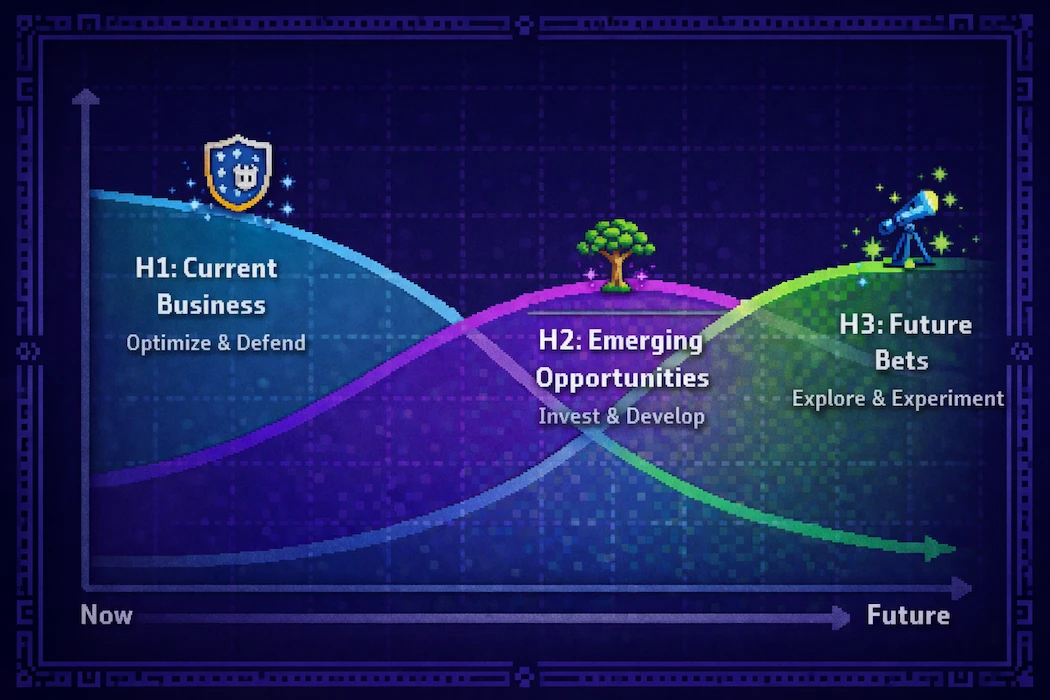
- Horizon 1: Current business, optimize and defend
- Horizon 2: Emerging opportunities, invest and develop
- Horizon 3: Future bets, explore and experiment
Most product strategy focuses on Horizon 1 and 2. Don't neglect H3 entirely, but be realistic about allocation.
Common Product Strategy Mistakes
Avoid these pitfalls:
1. Feature Lists Masquerading as Strategy
"Our strategy is to build X, Y, and Z features" is not a strategy. Features are outputs. Strategy explains WHY those features matter and how they connect to winning.
2. Trying to Please Everyone
A strategy that targets "all businesses" or "everyone who needs productivity tools" isn't focused enough to guide decisions. Specificity enables action.
3. Ignoring Competition
You don't operate in a vacuum. If your strategy doesn't account for competitive dynamics, you'll be surprised when the market shifts.
4. Strategy by Committee
Involving stakeholders in input is good. Letting everyone vote on strategic choices leads to compromise that pleases no one. Someone must make the call.
5. Never Updating
Markets change. Customers evolve. A two-year-old strategy is probably wrong. Review and refresh at least annually.
Product Strategy Template
To summarize, the product strategy should focus on business goals, market needs, and key product features and priorities. Here's a simple structure for documenting your strategy:
- Product Vision, The future state we're working toward
- Business Goals, What success looks like for the company
- Market Analysis, Landscape, competitive position, key trends
- Persona(s), Specific segment with needs and characteristics
- Development Team, Who will build it (optional)
- Product Features & Priorities, How we win against alternatives
- The Roadmap, The 3-5 themes guiding execution
- Numbers & Data, How we measure progress
Keep it concise. A 50-page strategy document won't get read. Aim for something your team can internalize and reference in daily decisions.
Strategy in Action: The Daily Test
Your strategy is working when team members can answer:
- "Should we build this feature?" → Does it serve our target customer and advance our differentiation?
- "Should we pursue this partnership?" → Does it accelerate our strategic priorities?
- "Should we respond to this competitor?" → Does it threaten our core positioning or distract from our focus?
If your team can't use your strategy to make these calls, the strategy isn't clear enough.
"Product managers are anthropologists. They're students of human behavior." Rich Mironov
The best product strategists don't just write documents. They deeply understand customers, markets, and their own organization. How you structure your organization directly shapes how strategy flows from vision to execution. They translate that understanding into choices that create focus. And they communicate those choices so clearly that the entire team can act on them.
Your product strategy is the most important artifact you'll create as a PM. Not because it's a document, but because it's the thinking that shapes everything your product becomes.

Need A Product Coach?
I help founders and product leads fix what's actually broken, hands-on. See how I can help.