Product Marketing: Start at Planning, Not at Launch
TL;DR: Product Marketing
- Product marketing connects what you build to the people who need it: positioning, messaging, go-to-market, and adoption.
- The part most teams miss: it starts at planning, not at launch. By launch, the product is already built around the wrong customer.
- Your customer sits in one of five awareness states. That state decides what you build and how you talk about it, not just how you advertise.
- Features tell, stories sell. The better you explain a customer's own problem back to them, the more authority they hand you.
- Pure selling is dead. Human voice, community, and real customer feedback are what move people now.
Product marketing connects what you build to the people who need it. It owns positioning, messaging, go-to-market, and adoption, and it lives at the intersection of product, sales, and marketing. Most guides stop there and hand you a list of responsibilities. This one goes further, because the responsibilities are not where teams lose. They lose by treating product marketing as a launch-phase activity, something you bolt on once the product is built. By then the product is already shaped around the wrong customer, and no amount of clever messaging fixes that.
What product marketing actually is

Product marketing is the work of understanding a specific customer deeply enough to build, position, and sell a product they actually want. Traditional marketing promotes a brand. Product marketing focuses on one product and the exact people it serves, and it translates customer reality into positioning, and product capability into stories that drive adoption.
The textbook responsibilities are real, and they matter:
- Market and customer research: the problems, the buying behavior, the language people use
- Positioning: how your product uniquely solves a problem worth paying for
- Messaging: the narrative that makes the value land for each audience
- Go-to-market: how the product reaches its market and converts
- Sales enablement: the tools and proof that help a deal close
- Customer feedback: the loop that keeps product and message honest
Research from the Product Marketing Alliance shows that 90,6% of product marketers own positioning and messaging, 78,7% run product launches, and 75,5% build sales collateral. That tells you where the function spends its time. It does not tell you where the edge is. The edge is upstream, before any of that, in a question most teams never ask early enough: who exactly is this for, and what do they already know?
I think of product marketing and product management as being two sides of the same coin. Martina Lauchengco, SVPG Partner
Great product marketing starts at planning, not at launch
Here is the thing almost nobody says out loud. Product marketing is not the thing you do to a finished product. It is a lens you apply at the very start, while you are still deciding what to build.
When I plan a product now, the marketing and distribution questions come first, not last. Who is this person? What do they already believe? How will they ever hear about this? If you cannot answer those during planning, you are building blind and hoping a launch fixes it. It will not. By launch, every expensive decision is already made.
This is the difference between first-time and second-time founders.
First time founders focus on product, second time founders focus on distribution. Monica Lent, Founder
Distribution is not a channel you pick at the end. It is a constraint you design into the product. Can it spread through normal use? Does using it create something worth sharing? Does it get more valuable as more people join? Can you reach buyers through a platform they already live in? Products with distribution baked in routinely beat objectively better products that bolted it on. The decision to bake it in happens at planning, or it does not happen at all.
The five states of customer awareness
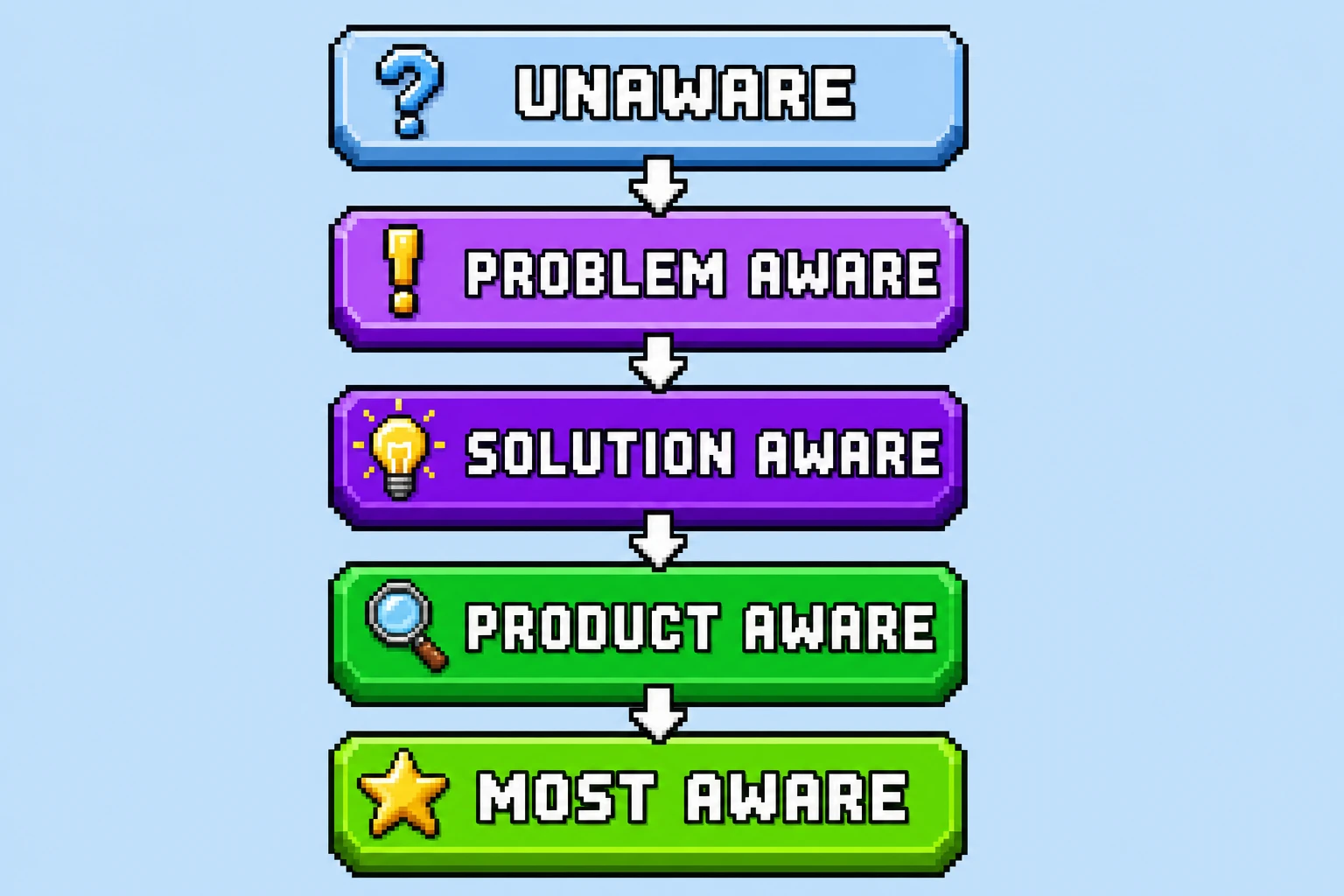
The single most useful model I have found for this comes from Eugene Schwartz's Breakthrough Advertising, written in 1966 and still the sharpest thing on the subject. Schwartz's idea is simple and brutal: you cannot create desire, you can only channel a desire that already exists. The job is to meet the customer where they already are. And where they are is one of five states of awareness.
| Awareness state | What the customer knows | What it changes for you |
|---|---|---|
| Unaware | Does not feel the problem yet | Do not pitch. Mirror who they are, then reveal the hidden problem. Education first. |
| Problem-aware | Feels the pain, sees no way out | Name and dramatize the problem, then present your approach as the way out. |
| Solution-aware | Knows solutions exist, not that yours delivers | Connect the known desire to your specific mechanism. |
| Product-aware | Knows your product, not sold yet | Sharpen why your way is better. Proof, mechanism, differentiation. |
| Most aware | Ready, just needs the nudge | Name the offer and ask. The direct call to action. |
Most people treat this as an advertising model, something the copywriter uses at the end. That is the mistake. Awareness state should shape the product itself.
A problem-unaware customer and a problem-and-solution-aware customer are not the same market, and they do not want the same product. If your buyer does not even know they have the problem, your product has to teach before it can sell, and that teaching is a feature, an onboarding flow, a piece of content, a whole surface area you have to build. If your buyer already knows the problem and has tried three competitors, you build proof, comparison, and a sharper mechanism instead. Same category, completely different product. You only know which one to build if you place your customer on this map during planning.
Awareness states sharpen your market sizing
This also fixes the laziest exercise in most plans: market sizing. TAM, SAM, and SOM usually get filled in with a top-down number pulled from a report. Awareness states give you a real one. Your serviceable, obtainable market is not everyone with the problem. It is the slice you can actually reach and convert at their current awareness stage, with the distribution you actually have. Size the market you can move, not the market that exists in theory.
Features tell, stories sell
Once you know who you are talking to and what they already know, the job is to tell a story, not to list features. This is my whole philosophy of product marketing in three words.
Features tell, stories sell.
A feature list talks about your product. A story talks about the customer. And customers do not want to hear about you, they want to hear about themselves.
It is not about your product. It is about them. Customers love to hear and learn about themselves, not about you. The better you can explain their problem, the more authority they give you.
That last line is the part that compounds. When you describe a person's situation more clearly than they can describe it themselves, something shifts. They assume that anyone who understands the problem this well must understand the solution. You earn authority not by claiming expertise but by demonstrating that you see them. The best positioning statement I have ever written did not mention a single feature. It described the customer's Tuesday afternoon.
Why pure selling stopped working
There is a reason the old playbook feels dead. Schwartz had a second axis: market sophistication, how many similar claims your buyer has already heard. Every interesting market today is late-stage. People have heard every promise, seen every "revolutionary" tool, and learned to ignore the pitch on reflex. Bare claims bounce off.
Two things still work in a claim-exhausted market. A genuinely new mechanism, a fresh how that makes the old promise believable again. And identification, bringing people in through who they are rather than what you promise. Both run on trust, and trust now comes from human voice, not corporate copy. This is exactly why communities and solo creators with real reach have become so powerful. A founder with an audience that trusts them can launch to demand on day one. A faceless brand shouting features cannot.
This is the quiet shift under everything. Product marketing used to be the art of the message. Now it is the art of being a credible human who customers believe, surrounded by other customers who vouch for you. The feedback, the opinions, the lived voices of real users carry more weight than anything you can say about yourself.
The four pillars of product marketing
With that foundation, the classic four-role framework finally makes sense, because each role is really a way of serving the customer's awareness, not promoting the product. Martina Lauchengco, SVPG Partner and author of Loved: How to Rethink Marketing for Tech Products, defines four roles every product marketer plays.
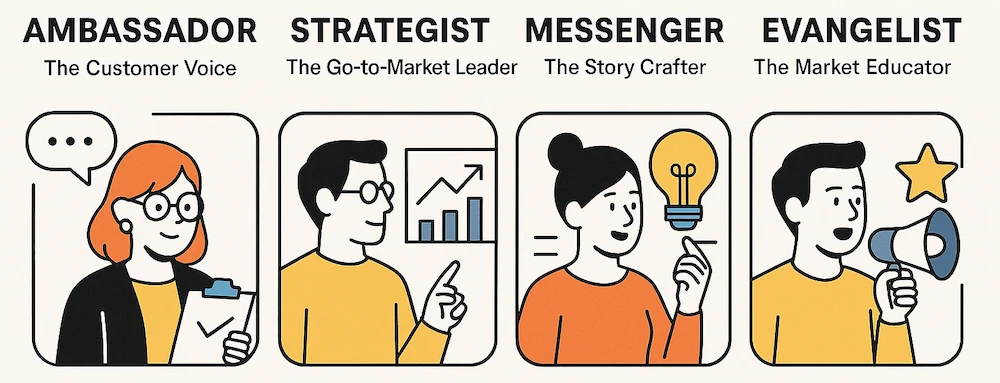
1. Ambassador, the customer voice
The ambassador brings the customer into every decision through interviews, win and loss analysis, and competitive sensing. This is where awareness-state thinking lives. It overlaps with product discovery and user research methods, with one difference of focus: discovery decides what to build, the ambassador decides how to position and sell it.
2. Strategist, the go-to-market leader
The strategist owns segmentation, pricing, channels, and the plan for how the product reaches its market. Strategy means hard choices: which segment first, which features to lead with, which competitor to position against. For the full method, see my go-to-market strategy guide.
You have to have that strategy, and strategy needs to precede all those other things. Martina Lauchengco
3. Messenger, the story crafter
The messenger turns capability into narrative. This role owns positioning, messaging, and content, and it is where features tell, stories sell becomes a daily craft. More on the mechanics in my product positioning guide. The best messaging never describes a feature. It describes the transformation, and it answers "so what?" for every capability.
4. Evangelist, the market educator
The evangelist builds awareness and credibility through thought leadership, community, and advocacy. In a late-stage market this role matters more than ever, because it is where the human voice and the trusted creator do their work. The evangelist makes sure the product is not just known, it is understood and believed.
Product marketing vs product management
Product managers and product marketers share one goal, product success, and approach it from two angles. The overlap is customer research, competitive intelligence, and launch planning. The split is clean once you name it.
| Dimension | Product management | Product marketing |
|---|---|---|
| Core question | What should we build and why? | How do we position and sell it? |
| Owns | The roadmap, features, shipping | Positioning, messaging, go-to-market |
| Works with | Engineering and design | Sales and marketing |
| Measures | Adoption, engagement, retention | Awareness, win rate, market perception |
Product and brand don't compete. Product IS brand. Laura Busche, Brand Strategist
Every product decision is a brand decision. How the product works, what it prioritizes, how it feels, all of it communicates as loudly as any campaign.
Product marketing when you are a team of one
Most product marketing advice assumes a department. If you are building solo, you are the product manager, the marketer, and the sales team at once, and you cannot run a four-role function. You do not need to. You need the minimum viable motion, and it is this.
Decide the awareness state of the person you are building for before you write a line of code, and build to that state. Talk to ten of them in their own words, then write your positioning as one sentence about their problem, not your product. Choose your one distribution channel during planning and build the product so it feeds that channel by being used. Then publish in public, in your own voice, and let the early users become the proof that converts the next ones. That is the entire function compressed into something one person can run, and it works because it front-loads the only decisions that matter. This is the same builder's lens I bring to product strategy and the reason 13 years of product management has become my edge as a solo builder rather than a thing I left behind.
Real examples through the awareness lens
The companies everyone cites make more sense once you read them as awareness plays.
Slack did not launch a chat tool, it created the "business communication" category and positioned against email, not other chat apps. That is a move for a problem-aware market that hated their inbox. Zoom entered a crowded, solution-aware market and won on one sharpened mechanism, it just works, while competitors listed enterprise features no one asked about. Notion leaned almost entirely on community and user-generated templates, the human-voice play, letting users become the marketing. Three different awareness states, three different strategies, one shared trait: each understood exactly who they were talking to and met them there.
Common product marketing mistakes
- Treating it as a launch activity. The expensive decisions are made during planning. Marketing that starts at launch can only decorate what already exists.
- Talking about yourself. Feature lists describe you. Customers care about them. Lead with their problem, every time.
- Ignoring awareness state. A message built for a solution-aware buyer is noise to an unaware one, and a pitch to an unaware buyer is spam.
- One message for everyone. Enterprise and SMB, technical and business buyers, none of them speak the same language or sit at the same awareness stage.
- Pure selling in a sophisticated market. Bare claims are dead. Without a new mechanism or a trusted human voice, the pitch bounces.
How product marketing connects to strategy
Product marketing does not run alone. It executes product strategy and gives product vision a market-facing voice. Strategy decides which markets, which problems, which position to own. Product marketing turns that into something a real person hears, believes, and buys. When the two align, positioning reflects strategy and the market validates it. When they drift, customers get mixed signals and stop listening.
Frequently asked questions
What is the difference between product marketing and product management? Product management decides what to build and ships it. Product marketing decides how to position and sell it, and drives adoption. They overlap on customer research and launches, and the best teams keep tight collaboration with clear ownership.
When does a company need a dedicated product marketer? When the product has traction and needs to scale adoption, when you enter a new segment or geography, when competition intensifies and differentiation gets hard, or when sales keeps losing deals on positioning. Before product-market fit, one person usually wears both the PM and PMM hats.
What are the awareness states in product marketing? Five, from Eugene Schwartz: unaware, problem-aware, solution-aware, product-aware, and most aware. Each describes how much the customer already knows, and each calls for a different message and, earlier than most people think, a different product.
Can a solo founder do product marketing alone? Yes, with the minimum viable motion: pick the customer's awareness state during planning, write positioning as one sentence about their problem, choose one distribution channel before building, and publish in your own voice so early users become the proof.
Start building the muscle
Whether your company has product marketers or not, understanding this makes you a sharper builder. Start with one question: can you state, in one sentence about the customer's problem, why someone should choose your product? Then place that customer on the awareness map, pick the one channel you will use to reach them, and design the product so using it feeds that channel. Do that during planning, and the launch takes care of itself.
If you want to build and sell products this way alongside other builders who think like product people and ship like solopreneurs, become a Product Baker and follow the build with me.

Need A Product Coach?
I help founders and product leads fix what's actually broken, hands-on. See how I can help.