How to Build a Go-to-Market Strategy: The 7-Step Framework
TL;DR: Go-to-Market Strategy
- Definition: A go-to-market (GTM) strategy is your plan for bringing a product to market and reaching customers.
- Why it matters: 95% of new products fail. Companies with structured GTM strategies see 3x greater revenue growth.
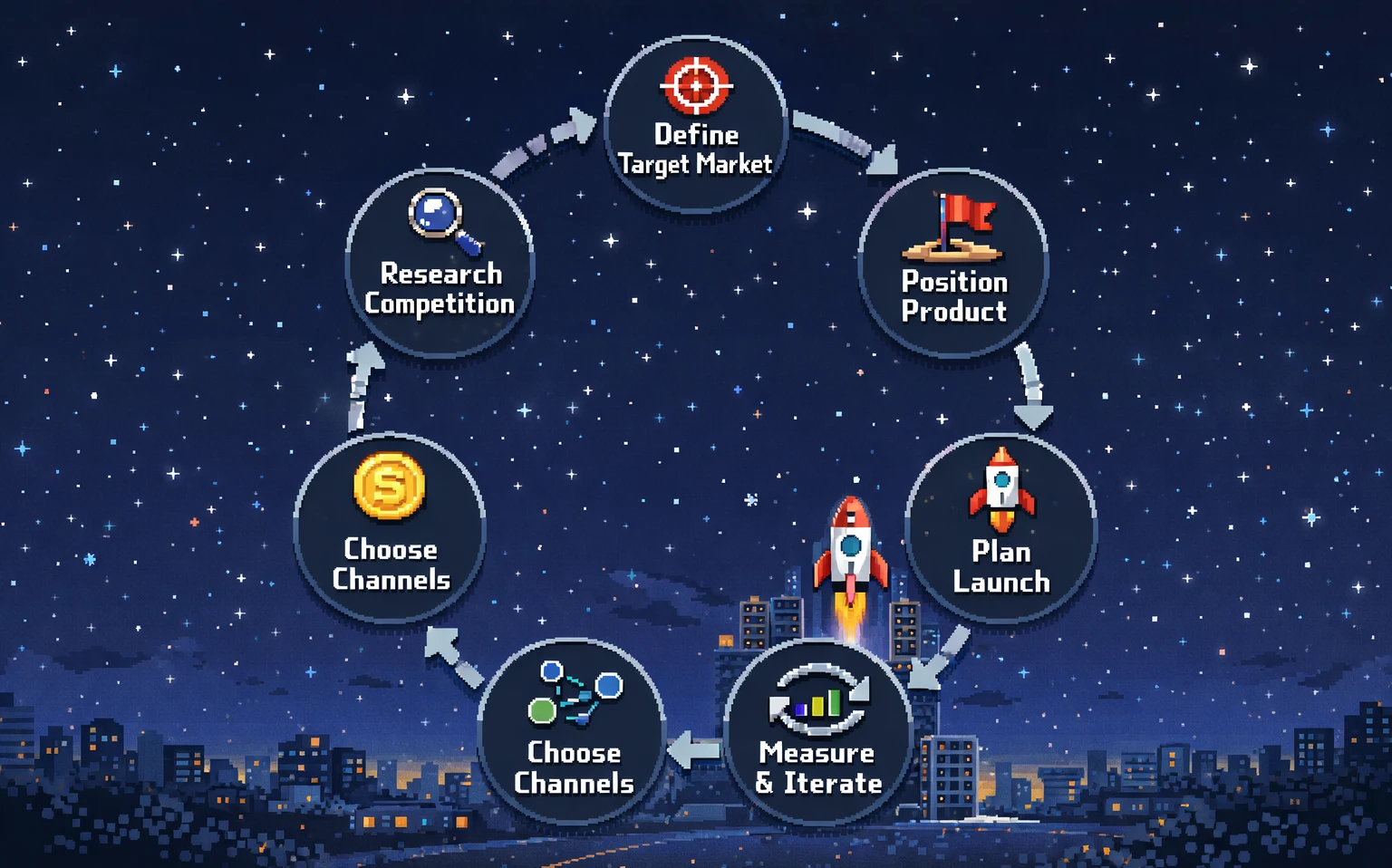
- The 7 Steps: Define market, research competitors, position product, choose channels, set pricing, plan launch, measure and iterate.
- Key insight: GTM goes beyond marketing. It's the bridge between building a product and getting it adopted.
A go-to-market strategy is the difference between a product that reaches customers and one that dies in obscurity. According to Harvard Business School professor Clayton Christensen, 95% of new products fail. The primary cause isn't poor product quality. It's poor go-to-market execution.
This guide gives you a practical 7-step framework for building a GTM strategy that actually works. New product launch, new market entry, or repositioning an existing offering, the steps below help you avoid the mistakes that sink most launches.
What Is a Go-to-Market Strategy?
A go-to-market strategy is a step-by-step plan for introducing a product to buyers. It defines who your target customers are, how you'll reach them, and how you'll guide them through the buyer's journey to purchase.
Unlike a general marketing plan that covers ongoing brand activities, a GTM strategy is launch-focused. It coordinates product, marketing, sales, and customer success around a specific market entry or expansion.
You have to have that strategy, and strategy needs to precede all those other things. (Martina Lauchengco, SVPG Partner)
A complete GTM strategy includes four core components:
- Market definition: Who you're selling to and why they need your product
- Positioning: How your product is different and better than alternatives
- Channels: How you'll reach customers and distribute your product
- Pricing: How you'll capture value and what customers will pay
For a deeper understanding of how GTM fits into the broader product marketing function, see my complete guide.
Why Go-to-Market Strategy Matters
The data on product launches is sobering. Beyond the 95% failure rate, Nielsen research shows that only 15% of consumer packaged goods remain commercially viable after two years.
But here's the opportunity: companies with a structured GTM framework see dramatically better outcomes. Research from the Product Marketing Alliance shows these companies achieve 3x greater revenue growth than those without a clear GTM process.
Yet only one-third of product marketers consistently follow a clear GTM process. This gap between knowing GTM matters and actually executing it represents a massive competitive opportunity.
The connection between GTM and product success runs deep. CB Insights analysis of 100+ startup post-mortems found that 35% of failures stemmed from weak product-market fit. Poor GTM execution is often what prevents companies from finding or demonstrating that fit.
When You Need a Go-to-Market Strategy
Not every product update requires a full GTM strategy. But certain situations demand one:
Launching a new product. First-time market entry requires defining your target audience, competitive positioning, and acquisition channels from scratch. Without a GTM strategy, you're guessing.
Entering a new market. Expanding to a new geography, industry vertical, or customer segment brings fresh challenges. The customer base may have different needs, buying behaviors, and expectations. Your existing playbook won't translate directly.
Repositioning an existing product. When competitive pressure or market shifts force you to change how customers perceive your product, you need a coordinated effort across all customer touchpoints.
Major product overhaul. Significant changes to functionality, pricing, or packaging require re-educating existing customers while attracting new ones. See our product launch checklist for execution details.
Types of Go-to-Market Strategies
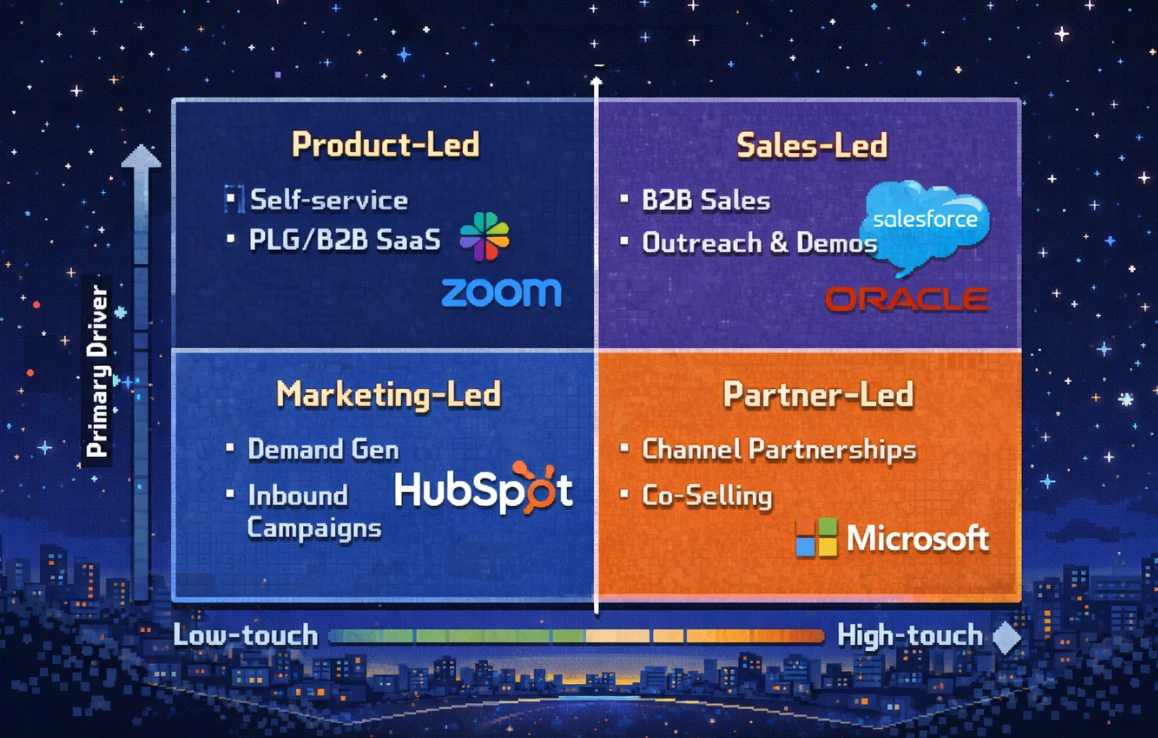
Before building your GTM strategy, understand the four primary approaches. Each has distinct characteristics, resource requirements, and ideal use cases.
| Strategy | Best For | Characteristics | Example |
|---|---|---|---|
| Sales-Led | Complex B2B, high ACV | Dedicated sales team, demos, negotiations, relationship-driven | Salesforce, Oracle |
| Product-Led | SaaS, immediate value | Free trials, self-service, viral loops, low-touch | Slack, Dropbox, Zoom |
| Marketing-Led | Brand awareness, content | Inbound marketing, content, SEO, demand generation | HubSpot |
| Partner-Led | Ecosystem plays | Channel partnerships, integrations, resellers | Microsoft partners |
Most successful companies combine elements of multiple approaches. Slack, for example, started product-led but added sales teams as they moved upmarket. The key is choosing your primary motion and building around it.
Product and brand don't compete. Product IS brand. (Laura Busche, Brand Strategist)
This insight is particularly relevant for product-led growth strategies, where the product experience itself becomes the primary marketing and sales tool.
How to Build a Go-to-Market Strategy: The 7-Step Framework
This framework works whether you're a startup launching your first product or an enterprise entering a new market. Each step builds on the previous one.
Step 1: Define Your Target Market
You can't build a GTM strategy for "everyone." The most common mistake is targeting too broadly too early. Start by narrowing your focus to a specific customer segment.
Create your Ideal Customer Profile (ICP). Define the characteristics of companies or individuals most likely to buy and succeed with your product:
- Company size, industry, and geography (B2B)
- Demographics, behaviors, and psychographics (B2C)
- Current solutions they use
- Budget and buying authority
- Technical requirements
Build buyer personas. Within your ICP, identify the specific people involved in purchase decisions. Document their roles, pain points, goals, and how they evaluate solutions.
Validate market size. Calculate your Total Addressable Market (TAM), Serviceable Addressable Market (SAM), and Serviceable Obtainable Market (SOM). This ensures the opportunity is worth pursuing.
For detailed techniques on understanding your target customers, see my guide to user research methods.
Step 2: Research Your Competition
Competitive research isn't about copying what others do. It's about finding positioning opportunities and gaps where you can differentiate.
Map the competitive landscape. Identify both direct competitors (same solution, same problem) and indirect competitors (different solution, same problem). Don't forget the "do nothing" alternative, which is often your biggest competitor.
Analyze positioning. For each competitor, document:
- Their core value proposition
- Target customer segments
- Pricing and packaging
- Key messaging and claims
- Strengths and weaknesses
Find your opportunity. Where are competitors weak? What do customers complain about? What needs remain unmet? Your GTM positioning should exploit these gaps.
Step 3: Define Your Value Proposition and Positioning
Your value proposition answers the question: "Why should I buy this instead of the alternatives?" Your positioning is how you want to be perceived relative to those alternatives. For more on positioning frameworks and examples, see my product positioning guide.
I think of product marketing and product management as being two sides of the same coin. (Martina Lauchengco, SVPG Partner)
This partnership matters because positioning must be grounded in real product capabilities. Empty promises destroy credibility.
Craft your value proposition. A strong value proposition includes:
- The problem you solve
- Your unique approach to solving it
- The specific benefit customers receive
- Why you're credible
Develop your messaging framework. Create messaging hierarchies for different audiences. Technical buyers care about different things than business buyers. Your messaging should adapt while maintaining core positioning.
Your GTM positioning should align with your broader product strategy, which defines your choices about where to play and how to win.
Step 4: Choose Your Channels
Channel strategy determines how you'll reach customers and distribute your product. The right channels depend on where your target customers spend time and how they prefer to buy.
Distribution channels:
- Direct (your own sales team or website)
- Partners and resellers
- Marketplaces (app stores, aggregators)
- Integrations and embedded solutions
Marketing channels:
- Content marketing and SEO
- Paid advertising (search, social, display)
- Events and conferences
- PR and analyst relations
- Community and social media
Sales channels:
- Inside sales (phone/video)
- Field sales (in-person)
- Self-service (no sales involvement)
- Channel partners
Match channels to customer behavior. If your buyers research extensively online before talking to sales, invest in content. If they rely on peer recommendations, focus on community and referrals.
Step 5: Develop Your Pricing Strategy
Pricing is one of the most powerful levers in your GTM strategy. It signals value, affects positioning, and directly impacts revenue.
Choose your pricing model:
- Subscription: Recurring revenue, predictable for both parties
- Usage-based: Pay for what you use, low barrier to entry
- Freemium: Free tier with paid upgrades, drives adoption
- One-time: Single purchase, simpler but less predictable
- Tiered: Multiple packages at different price points
Set your price point. Consider:
- Competitive pricing (what alternatives cost)
- Value-based pricing (what it's worth to customers)
- Cost-plus pricing (your costs plus margin)
Value-based pricing typically yields the best results but requires deep customer understanding. Test pricing with real customers before committing.
Step 6: Plan and Execute Your Launch
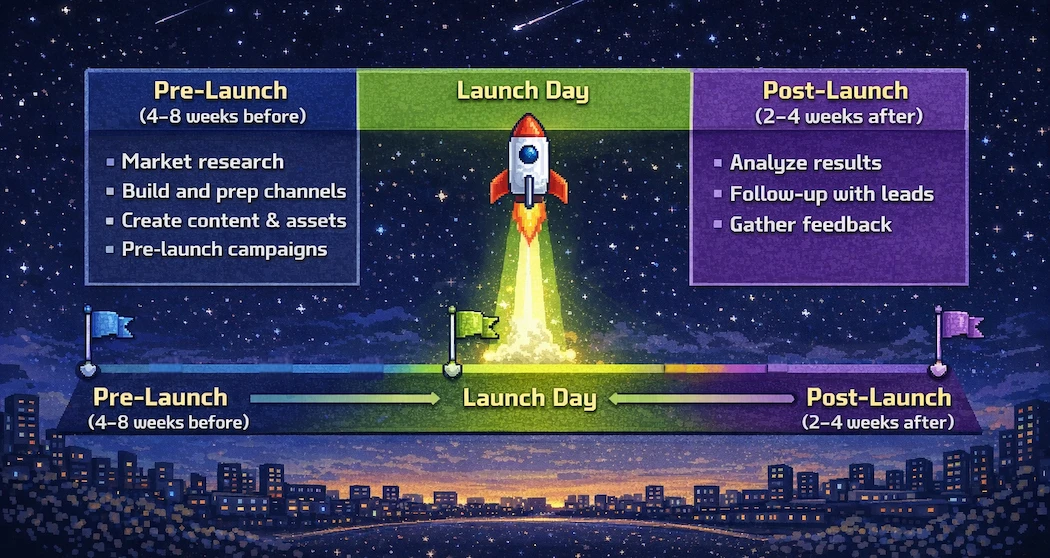
Launch planning brings together everything from the previous steps into coordinated action. A launch isn't a single day. It's a process with distinct phases.
Pre-launch (4-8 weeks before):
- Build anticipation through content and early access
- Train sales and support teams
- Prepare marketing assets and campaigns
- Run beta programs to gather feedback
- Set up measurement and analytics
Launch:
- Coordinate cross-functional execution
- Execute communication plan
- Monitor key metrics closely
- Respond quickly to issues
Post-launch (first 2-4 weeks):
- Gather customer feedback
- Analyze performance against goals
- Iterate on messaging and targeting
- Document learnings
If you are thinking about a product, you need to be thinking about the marketing side and the go-to-market side. Product management and product marketing should see themselves as partners in how the product as well as the go-to-market gets developed. (Martina Lauchengco, SVPG Partner)
For a detailed launch execution guide, see my 25-step product launch checklist.
Step 7: Measure and Iterate
A GTM strategy isn't a one-time document. It's a living system that improves through measurement and iteration.
Define success metrics by GTM type:
| GTM Type | Primary Metrics |
|---|---|
| Sales-Led | Win rate, sales cycle length, average contract value, pipeline coverage |
| Product-Led | Activation rate, time to value, viral coefficient, expansion revenue |
| Marketing-Led | Customer acquisition cost, conversion rate, organic traffic, MQL to SQL ratio |
| Partner-Led | Partner-sourced revenue, partner activation rate, deal registration |
Establish review cadence:
- Weekly: Tactical metrics, campaign performance, pipeline health
- Monthly: Funnel analysis, win/loss review, channel performance
- Quarterly: Strategic review, positioning effectiveness, market changes
The best GTM strategies evolve continuously based on what the data reveals.
Go-to-Market Strategy Examples
Understanding how successful companies executed their GTM strategies provides practical inspiration.
Slack: Product-Led GTM
Slack's GTM strategy centered on the product experience itself. Key elements:
- Viral mechanics: Team-based product naturally spread through organizations
- Freemium model: Generous free tier lowered adoption barriers
- Bottom-up adoption: Individual teams adopted, then expanded to departments and companies
- "Where work happens" positioning: Differentiated from email and existing tools
Slack achieved $1B ARR faster than any SaaS company at the time, largely through product-led growth before adding enterprise sales.
Zoom: Simplicity-Focused GTM
Zoom entered a crowded video conferencing market dominated by established players. Their GTM approach:
- "It just works" positioning: Emphasized reliability over features
- Free tier strategy: 40-minute limit on group calls drove paid conversion
- Word-of-mouth focus: Every call was a product demo
- Enterprise readiness: Security and admin features enabled upmarket expansion
Zoom's GTM succeeded by solving the core job better than anyone else, then letting the product spread naturally.
Salesforce: Sales-Led GTM
Salesforce pioneered enterprise SaaS with a sales-led GTM approach:
- "No software" positioning: Differentiated against on-premise solutions
- Heavy sales investment: Built large direct sales organization
- Events as channel: Dreamforce became the industry's largest conference
- Ecosystem strategy: AppExchange created partner-driven growth
Salesforce's GTM required significant capital but built a dominant market position in enterprise CRM.
Common Go-to-Market Mistakes
Learning from others' failures is more efficient than making your own. These mistakes appear repeatedly in unsuccessful GTM efforts.
1. Launching without a clear ICP. Trying to sell to everyone means selling to no one effectively. Your messaging becomes generic, your sales team wastes time on poor-fit prospects, and your product roadmap lacks focus.
2. Ignoring competitive positioning. "We have no competitors" is almost never true. Even if no direct competitor exists, customers have alternatives (including doing nothing). Failing to position against these alternatives leaves customers confused about your value.
3. Misaligning channels with product. An enterprise product with only self-serve acquisition will struggle. A low-ACV product with expensive field sales will never be profitable. Match your channels to your product economics.
4. Premature scaling. Pouring resources into growth before achieving product-market fit is the fastest way to burn cash. Validate that customers actually want what you're selling before scaling acquisition.
5. No measurement framework. "We'll figure out metrics later" means you'll never know what's working. Define success criteria before launch, not after.
According to Harvard Business Review, 60-90% of strategic plans never fully launch. The cause? Poor execution and lack of a holistic approach to strategy.
Go-to-Market Strategy Checklist
Use this checklist to ensure your GTM strategy covers all essential elements:
Market Definition
- Ideal Customer Profile documented
- Buyer personas created
- Market size validated (TAM/SAM/SOM)
- Customer pain points identified
Competitive Positioning
- Competitive landscape mapped
- Differentiation clearly defined
- Value proposition articulated
- Messaging framework developed
Channel Strategy
- Distribution channels selected
- Marketing channels prioritized
- Sales model defined
- Partner strategy (if applicable)
Pricing and Packaging
- Pricing model chosen
- Price points set
- Packaging/tiers defined
- Competitive pricing analyzed
Launch Execution
- Launch timeline created
- Cross-functional alignment confirmed
- Marketing assets prepared
- Sales enablement complete
Measurement
- Success metrics defined
- Tracking and analytics set up
- Review cadence established
- Iteration process defined
Build Your GTM Strategy
A go-to-market strategy transforms product potential into market reality. It's the bridge between building something valuable and getting it into customers' hands.
The 7-step framework in this guide provides a proven structure: define your market, research competitors, position your product, choose channels, set pricing, plan your launch, and measure results. Each step builds on the previous one, creating a comprehensive approach to market entry.
Remember that GTM strategy isn't a document you write once and forget. Markets change, competitors evolve, and customer needs shift. The best GTM strategies are living systems that improve through continuous measurement and iteration.
Start with the fundamentals: know your customer deeply, position clearly against alternatives, and measure what matters. Everything else builds from there.
I am happy to discuss your specific situation on LinkedIn.

Need A Product Coach?
I help founders and product leads fix what's actually broken, hands-on. See how I can help.