OKR Workshop: How to Run Goal-Setting Sessions That Work
TL;DR: OKR Workshop
- Core idea: A good OKR workshop produces 3-5 focused Objectives in 4 hours, not 10 vague ones in 8 hours
- Biggest mistake: Letting the loudest person in the room dominate the Objective brainstorm
- Workshop structure: Pre-work (2 weeks) + 4-hour session + follow-up (Weeks 1, 4, Mid-Quarter)
- Key insight: The facilitator's job is not to write OKRs. It is to create the conditions for the team to write their own
- Bottom line: If your OKR planning takes six weeks every quarter, you need a better workshop, not more meetings
An OKR workshop is a structured session where a team collectively defines Objectives and Key Results for the upcoming quarter. Most OKR workshops fail not because teams write bad goals, but because the facilitator does not manage the room. After running dozens of these sessions, the pattern is clear: the workshop agenda matters less than what happens between the agenda items. This guide gives you a complete 4-hour workshop template, facilitation techniques for the hardest moments, and a post-workshop follow-up plan that keeps OKRs alive beyond the first week.
What Is an OKR Workshop?
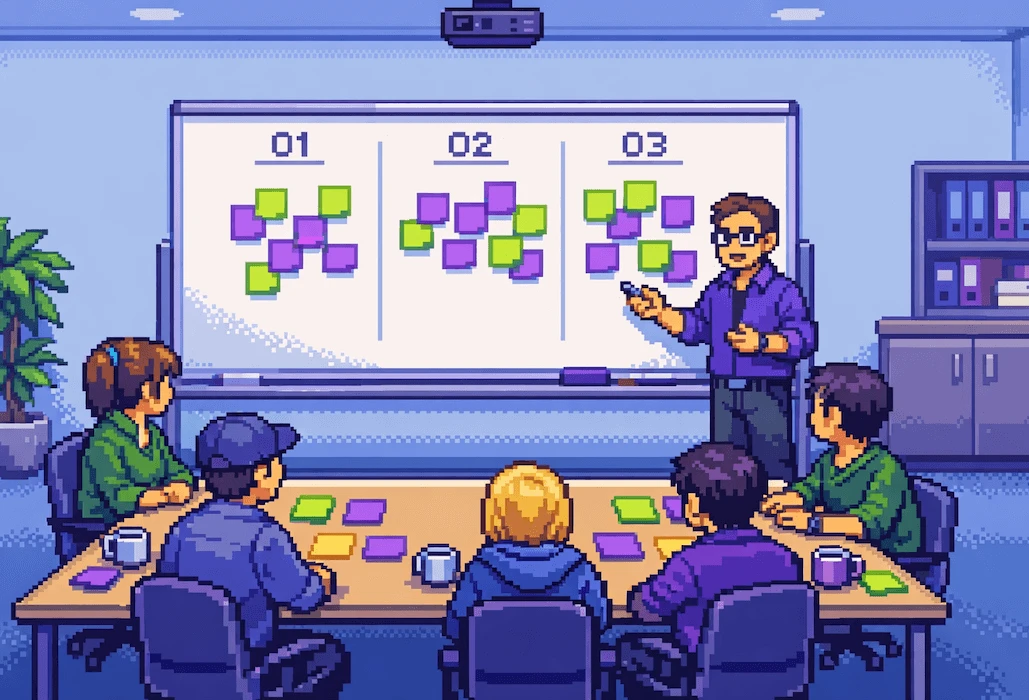
An OKR workshop is a facilitated group session where a team collaboratively writes their Objectives and Key Results for the next quarter. Unlike a regular planning meeting where a manager presents goals for approval, a workshop requires active participation from everyone in the room. The facilitator guides the process. The team owns the output.
When should you run an OKR workshop? Three situations call for one. First, quarterly planning cycles: this is the most common trigger, and most teams benefit from a dedicated workshop rather than trying to define OKRs through a series of meetings and email threads. Second, new team formation: when a team is newly assembled and needs to align on shared goals for the first time. Third, strategic pivots: when the company direction has shifted and existing OKRs need a reset. For a deeper understanding of the OKR framework itself, see the complete guide to OKRs.
Who should be in the room? Keep it to 5-8 people. Include cross-functional representation (product, engineering, design) and at least one decision-maker who can approve the final OKRs. Larger groups slow the process down and make it harder for quieter participants to contribute. If you have 12 people, split into two workshops and run an alignment session afterward.
The distinction between a workshop and a meeting matters more than most teams realize. A meeting is for sharing information: someone presents, others listen, questions get asked. A workshop is for collaborative creation: everyone contributes, ideas build on each other, and the group produces something together that no individual could have produced alone. When you call it a "workshop" but run it like a meeting, you get the worst of both worlds: a long session where the loudest person dictates the goals while everyone else checks their email.
"If every quarter it takes six weeks to have OKRs ready, you're losing six weeks of execution." (Christian Strunk)
That quote captures why the workshop format matters. A well-run 4-hour workshop replaces weeks of back-and-forth emails, Slack threads, and alignment meetings. You walk in with context and pre-work. You walk out with draft OKRs that the team actually believes in.
Pre-Workshop Preparation (2 Weeks Out)
The workshop itself is 4 hours. The preparation takes 2 weeks. This is not optional. In my coaching experience, the teams that skip pre-work spend the first hour of the workshop catching up on context instead of brainstorming Objectives.
Week -2: Send the context package. Email all participants the company-level OKRs, last quarter's results with scores, and the top 3 strategic priorities for the upcoming quarter. This gives everyone two weeks to process the context before they walk into the room. Include any relevant customer feedback or market data that should inform the next quarter's priorities.
Week -1: Individual pre-work. Ask each participant to bring 2-3 draft Objectives written on index cards or in a shared document. These are conversation starters, not final proposals. The pre-work ensures that the brainstorm session in the workshop builds on prepared thinking rather than starting from scratch. Emphasize that draft quality does not matter. What matters is that everyone arrives with ideas they have thought about for at least a few days.
Day before: Set up the space. For in-person workshops: whiteboard, sticky notes, dot voting stickers, timer visible to all participants. For virtual workshops: a collaborative board (Miro, FigJam), breakout rooms configured, and a shared timer. Test the technology in advance. Nothing kills workshop momentum faster than spending the first 20 minutes troubleshooting a video call.
Facilitator prep: Review last quarter's OKR scores and identify patterns. Which Objectives scored Orange or Red? Which Key Results were written as tasks instead of outcomes? Prepare 3-5 coaching questions based on these patterns. For example, if the team consistently writes output-focused Key Results, prepare the question: "What will change for our users if we do this well?"
| Timeline | Action | Owner | Purpose |
|---|---|---|---|
| 2 weeks before | Send context package (company OKRs, last quarter scores, strategic priorities) | Facilitator | Give participants time to absorb context |
| 1 week before | Each participant prepares 2-3 draft Objectives | All participants | Ensure prepared thinking before brainstorm |
| 1 week before | Review last quarter's OKR patterns and prepare coaching questions | Facilitator | Target specific improvement areas |
| Day before | Set up workshop space (physical or virtual) | Facilitator | Remove logistics friction on workshop day |
The OKR Workshop Agenda (4 Hours)
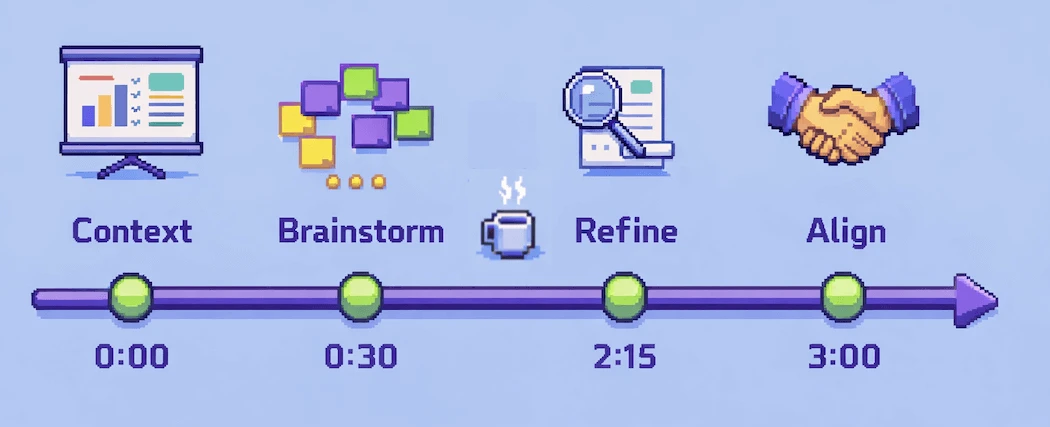
In my coaching experience, the most productive OKR workshops have a strict 4-hour timebox. After 4 hours, energy drops and Objectives become vague. The following agenda has been tested across startups, scale-ups, and enterprise teams. Adjust the time blocks to fit your context, but keep the total under 4 hours.
| Time | Activity | Facilitator Notes | Output |
|---|---|---|---|
| 0:00 - 0:30 | Context setting | Present company OKRs, last quarter scores, strategic priorities. Keep it factual, not persuasive. | Shared understanding of direction |
| 0:30 - 1:00 | Silent brainstorm + dot voting | Each person writes Objectives on sticky notes (silent, no discussion). Then dot-vote on favorites (3 votes each). | Ranked list of candidate Objectives |
| 1:00 - 1:30 | Objective selection | Discuss top-voted Objectives. Merge similar ones. Select 3-5 for the quarter. | 3-5 agreed Objectives |
| 1:30 - 2:00 | Key Results drafting (pairs) | Assign pairs to each Objective. Draft 2-4 Key Results per Objective. Pairs force conversation. | Draft Key Results for each Objective |
| 2:00 - 2:15 | Break | Mandatory. Energy drops sharply after 2 hours without a pause. | Refreshed participants |
| 2:15 - 3:00 | Key Results refinement | Each pair presents their Key Results. Group coaching round: Are KRs measurable? Ambitious enough? Outcome-based? | Refined Key Results with baselines and targets |
| 3:00 - 3:45 | Alignment + dependencies | Identify cross-team dependencies. Assign an owner to each Objective. Flag risks and resource constraints. | Owned OKRs with dependency map |
| 3:45 - 4:00 | Confidence scoring + close | Each person rates confidence (1-10) that the team can achieve each Objective. Discuss any score below 6. | Confidence baseline for quarterly tracking |
The silent brainstorm in Hour 1 is the most important design choice in this agenda. When brainstorming is verbal, the first person to speak anchors the conversation. Everyone else either builds on that first idea or reacts to it. Silent writing followed by dot voting ensures every voice is represented before discussion begins. This one technique dramatically changes the quality and diversity of Objectives.
The pairs-based Key Results drafting in Hour 2 is equally deliberate. Writing Key Results alone produces metrics nobody challenges. Writing them as a group of 8 produces chaos where the strongest personality wins. Pairs create just enough friction to sharpen thinking without slowing the process down. Each pair has to agree that a Key Result is measurable, which catches vague metrics before they reach the full group.
The Coaching Layer: What Happens Between the Agenda Items
The agenda gets you through the 4 hours. The coaching layer determines whether the OKRs are any good. Every workshop hits predictable friction points. Here is how to handle each one.
When One Person Dominates
This happens in almost every workshop, especially when a senior leader is in the room. The symptom is obvious: one person talks for 80% of the discussion while the rest of the team nods along. The fix is structural, not confrontational. Use the redirect technique: "That is a strong perspective. Let us hear from someone who has not spoken yet." Then go around the table, giving each person 60 seconds to share their view. If the dominant person is the most senior person in the room, establish a ground rule at the start: "In this workshop, titles stay outside the room. Every sticky note carries equal weight." Silent brainstorming and dot voting help too, because they remove the speaking-order advantage entirely.
When the Team Writes 10 Objectives
This is the second most common problem. The team is excited, the brainstorm produces a wall of sticky notes, and nobody wants to cut anything. The coaching question that works every time: "If you could only keep 3 of these, which would you cut?" Force the prioritization conversation. The discomfort of cutting is the point. Remind the team that cutting an Objective does not mean the work disappears. It means it is not a top-3 priority this quarter. Three focused Objectives that the team fully commits to will always outperform ten scattered ones that nobody owns.
When Key Results Are Not Measurable
A team writes "Improve customer onboarding experience" as a Key Result. That is an Objective disguised as a Key Result. The coaching move: ask "How would you know if the onboarding experience improved? What number would change?" This usually surfaces something measurable: "Reduce time-to-first-value from 5 minutes to 2 minutes" or "Increase Day 7 activation rate from 35% to 50%." The rule of thumb: if you cannot put a number on it today and compare it to a number next quarter, it is not a Key Result yet. Push the team to find the metric hiding inside their vague statement.
When Someone Proposes an Output Instead of an Outcome
"Ship the new dashboard by March" is an output. It describes what the team will build, not what will change because they built it. The coaching question: "What happens after you ship the dashboard? What user behavior changes?" This reframes the conversation from delivery to impact. The output becomes a task on the roadmap. The outcome becomes the Key Result: "Increase self-service data access from 20% to 60% of weekly decisions." Outputs are important for planning, but they belong on your product roadmap, not in your OKRs.
"Starting with why is a big one. The more you explain that why, the more you empower teams." (Cindy Alvarez, GitHub)
This principle from Cindy Alvarez applies directly to workshop facilitation. When a team understands why their Objectives matter, they write better Key Results and push back on weak ones without the facilitator needing to intervene. The facilitator's job is empowering team ownership of the goals, not policing the OKR format.
Before and After: OKR Coaching Transformations
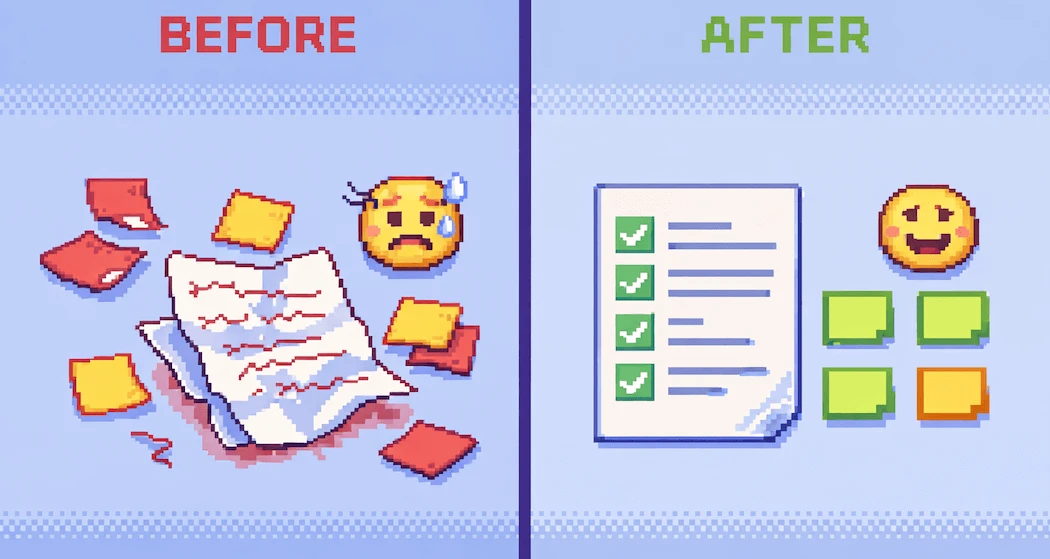
The difference between a first-draft OKR and a coached version is often dramatic. Here are examples of how facilitation transforms workshop output from vague intentions into focused, measurable goals.
| Workshop Draft (Before) | Coached Version (After) | What Changed |
|---|---|---|
| O: Improve customer satisfaction | O: Become the #1 rated product in our G2 category | Vague aspiration replaced with specific, competitive benchmark |
| KR: Launch feature X by March | KR: Increase activation rate from 25% to 40% | Output (ship something) replaced with outcome (user behavior change) |
| O: Grow revenue | O: Achieve $500K ARR with 90% from organic channels | Generic goal replaced with specific target and quality constraint |
| KR: Reduce churn | KR: Reduce monthly logo churn from 8% to 4% | Missing baseline and target added, metric type specified (logo vs revenue churn) |
| KR: Make onboarding better | KR: Reduce time-to-first-value from 5 minutes to 90 seconds | Subjective assessment replaced with measurable user experience metric |
"You need success metrics based on facts. Otherwise you can't argue or justify anything." (Matthias, Product Lead)
The pattern across all these transformations is the same: the coached version has a baseline, a target, and measures an outcome rather than an activity. For more examples across different industries and team types, see real-world OKR examples.
Workshop Variations by Company Stage
Not every team needs the same workshop. A 5-person startup and a 500-person enterprise have different dynamics, different decision-making structures, and different common failure modes. The workshop should reflect that.
| Aspect | Startup (5-15 people) | Scale-up (15-100 people) | Enterprise (100+ people) |
|---|---|---|---|
| Duration | 2 hours | 4 hours | Full day (with breaks) |
| Participants | Entire company | Team leads + key ICs | Department + cross-functional reps |
| Facilitator | Founder or external coach | Product lead or Scrum Master | Dedicated OKR coach or external facilitator |
| Objectives per team | 2-3 (company-wide) | 3-5 (per team) | 3-5 (per department, cascaded) |
| Common pitfall | Founder dominates the brainstorm | Teams write OKRs in silos without cross-team alignment | Corporate language replaces meaningful goals |
Startups can skip the elaborate pre-work phase because everyone already has full context. The risk is that the founder writes the OKRs and calls it a "workshop." Scale-ups face a coordination challenge: multiple teams need aligned OKRs, and the workshop must include time for cross-team dependency mapping. Enterprise teams struggle with a different problem entirely. The language becomes so polished and corporate that the OKRs lose their edge. If an Objective could appear in any company's annual report, it is too generic. For strategies to avoid these pitfalls at every stage, see common OKR pitfalls that I have collected from coaching teams across all company sizes.
Post-Workshop Follow-Up
Most OKR resources stop at the workshop. That is a mistake. In my coaching experience, the follow-up is where OKRs either become a living tool or a forgotten document. A workshop without follow-up is like planting seeds and never watering them.
| Timing | Action | Participants | Coaching Focus |
|---|---|---|---|
| Week 1 | Share finalized OKRs, assign owners, set up tracking | Full team + stakeholders | Ensure everyone can articulate the OKRs without checking a document |
| Week 4 | First progress check-in (15 min) | OKR owners + facilitator | Are teams actually tracking? Surface early blockers before they compound |
| Mid-Quarter | Confidence scoring (rate each OKR 1-10) | Full team | Any confidence score below 6 triggers a course-correction conversation |
| End of Quarter | Scoring + retrospective (2 hours) | Full team + facilitator | Score each KR, identify what worked in the workshop, plan improvements for next cycle |
The Week 4 check-in is the most critical touchpoint in the entire follow-up cycle. It catches the pattern I see in the majority of teams: everyone leaves the workshop energized, the OKRs get documented beautifully, and then nothing measurable happens for 8 weeks. By Week 4, the team has had enough time to start execution but not enough time for problems to become unfixable. A 15-minute check-in at this point breaks the "set and forget" pattern by forcing the team to look at actual progress numbers, not just good intentions. Track your product KPIs alongside OKR progress to get the full picture of team health and performance.
The end-of-quarter retrospective closes the loop. Score each Key Result, calculate the Objective score, and then spend 90 minutes on the retrospective itself. Two questions matter most: "What would we do differently in the workshop?" and "What helped us execute this quarter?" Feed these insights directly into the next workshop's pre-work so the cycle improves every quarter.
Conclusion
The workshop is the starting line, not the finish line. A well-facilitated 4-hour session produces focused, measurable OKRs that the team genuinely owns. The pre-work ensures prepared thinking. The coaching layer catches weak Objectives before they become quarterly regrets. The follow-up keeps the OKRs alive long after the sticky notes come off the whiteboard.
The best OKR workshops I facilitate are the ones where I say the least. When the team is debating whether a Key Result is ambitious enough without my prompting, the workshop is working. The facilitator's job is to create the conditions for the team to own their goals, then get out of the way.
What has worked (or not worked) in your OKR workshops? Connect with me on LinkedIn to share your experience.

Need A Product Coach?
I help founders and product leads fix what's actually broken, hands-on. See how I can help.