The OKR Framework: How to Set Goals That Drive Results

TL;DR: The OKR Framework
The OKR framework connects an ambitious objective, what you want to achieve, with two to four key results that show whether you achieved it.
- The effect: OKRs create focus, alignment and ownership through stretch goals the team writes itself.
- The bar: 70 % achievement of an ambitious goal counts as success, the standard Google set.
- The numbers: 83 % of companies using OKRs report a positive impact, and weekly check-ins raise goal completion by 43 %.
- The habit: Fifteen minutes a week to review progress and a 30-minute team session to write them.
- The mistake: Treating OKRs as a template to fill out instead of a way of thinking about goals.
What Is the OKR Framework?
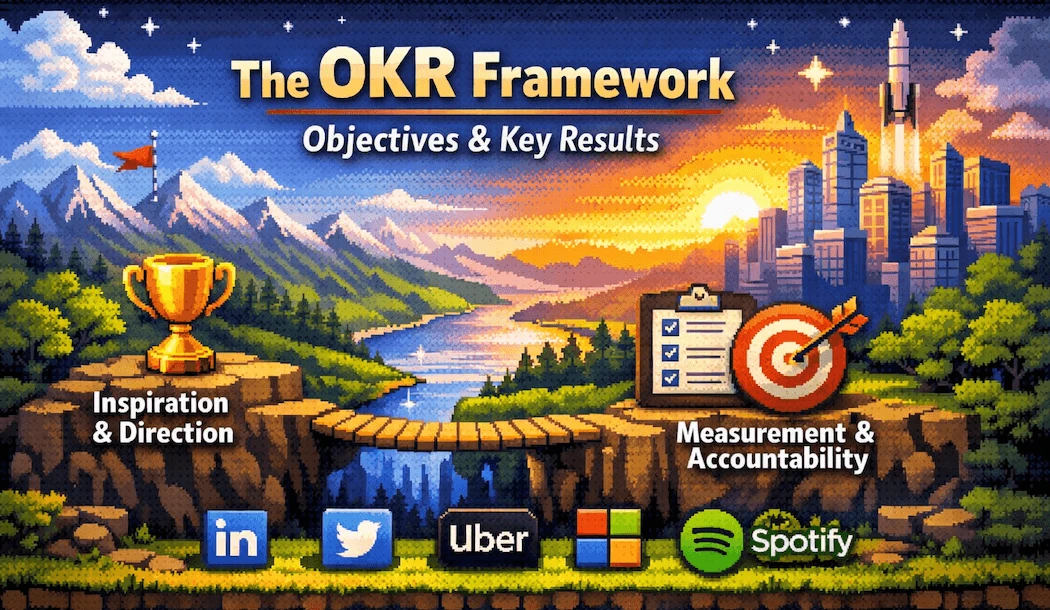
The OKR framework is a goal-setting methodology that connects ambitious objectives to measurable outcomes. OKR stands for Objectives and Key Results: the Objective is what you want to achieve, and Key Results are how you'll know you've achieved it.
According to Mooncamp's 2022 OKR Impact Report, 83% of companies using OKRs report a positive impact on their organization. But most implementations fail not because of the framework itself, they fail because teams treat OKRs like a template to fill out rather than a way of thinking about goals.
Andy Grove developed OKRs at Intel in the 1970s, building on Peter Drucker's Management by Objectives. John Doerr, who learned the framework at Intel, introduced it to Google in 1999 when the company had just 40 employees. Today, Google has over 100,000 employees and credits OKRs as central to their culture of ambitious goal-setting.
The framework's genius is its simplicity: Objectives provide direction and inspiration, while Key Results provide measurement and accountability. An Objective without Key Results is just wishful thinking. Key Results without an Objective are just metrics without meaning.
Companies like LinkedIn, Twitter, Uber, Microsoft, and Spotify have all adopted OKRs. But success isn't about copying what Google does, it's about understanding the principles and adapting them to your context.
Why the OKR Framework Actually Works
Many organizations adopt OKRs expecting magic results, then abandon them after a few quarters of frustration. The difference between success and failure often comes down to understanding why OKRs work, not just how to format them.
The Psychology of Stretch Goals
OKRs are built on stretch goals: ambitious targets that feel uncomfortable but possible. Research by Edwin Locke and Gary Latham established that specific, challenging goals lead to higher performance than easy goals or vague "do your best" instructions. Their goal-setting theory, developed over decades of research starting in the 1960s, shows that difficult goals focus attention, increase persistence, and trigger creative problem-solving.
Locke and Latham's research found that people who set specific, challenging goals perform 90% better than those who set easy goals or no goals at all. The mechanism is straightforward: stretch goals force you to question assumptions, explore new approaches, and allocate resources more thoughtfully. Easy goals let you coast on existing habits.
Daniel Pink's research in Drive adds another dimension: intrinsic motivation comes from autonomy (choosing how to achieve goals), mastery (getting better at meaningful work), and purpose (connecting work to something larger). Well-implemented OKRs activate all three: teams have autonomy in how they pursue objectives, Key Results create clear markers of mastery, and well-crafted objectives connect daily work to organizational purpose.
This is why Google targets 70% achievement as success. Consistently hitting 100% means your goals aren't ambitious enough. The stretch creates the growth. Ken Norton, former Google product manager, puts it well: "If you set crazy ambitious goals and miss them, you've probably still achieved something remarkable."
"If you understand the value you're creating, or if you don't, you better figure it out. But if you do understand the value, measuring it should be pretty straightforward." Ben Yoskovitz, Lean Analytics author
Focus and Alignment
Beyond individual psychology, OKRs solve an organizational problem: alignment. In growing companies, teams naturally drift in different directions. Marketing optimizes for one metric while Product optimizes for another. Engineering builds what they find interesting while Sales promises features that don't exist.
OKRs create shared language and shared priorities. When everyone can see what everyone else is working toward, alignment happens naturally. Teams coordinate because they understand dependencies. Conflicts surface early because priorities are explicit. Resources flow to what matters because what matters is visible.
This transparency has a secondary effect: it surfaces bad ideas faster. When your OKRs are visible to the entire organization, you think harder about whether they make sense. Peer review happens automatically.
Employee Engagement and Satisfaction
The impact isn't just theoretical. A study by Haufe Talent and Stuttgart University of Applied Sciences found that 78% of employees using OKRs are satisfied with their jobs, compared to only 65% in companies without OKRs. The framework provides clarity about priorities and creates transparency about how individual work connects to organizational goals.
When Sears Holding Company implemented OKRs consistently, they saw an 8.5% increase in sales per hour within 18 months. Employees who used OKRs all year had an 11.5% higher likelihood of high performance compared to those with inconsistent use.
The engagement boost comes from clarity. People want to know that their work matters. OKRs make the connection explicit: "This is what we're trying to achieve as an organization. This is how your team contributes. This is how your work moves the needle." That clarity is energizing.
The Anatomy of a Good OKR
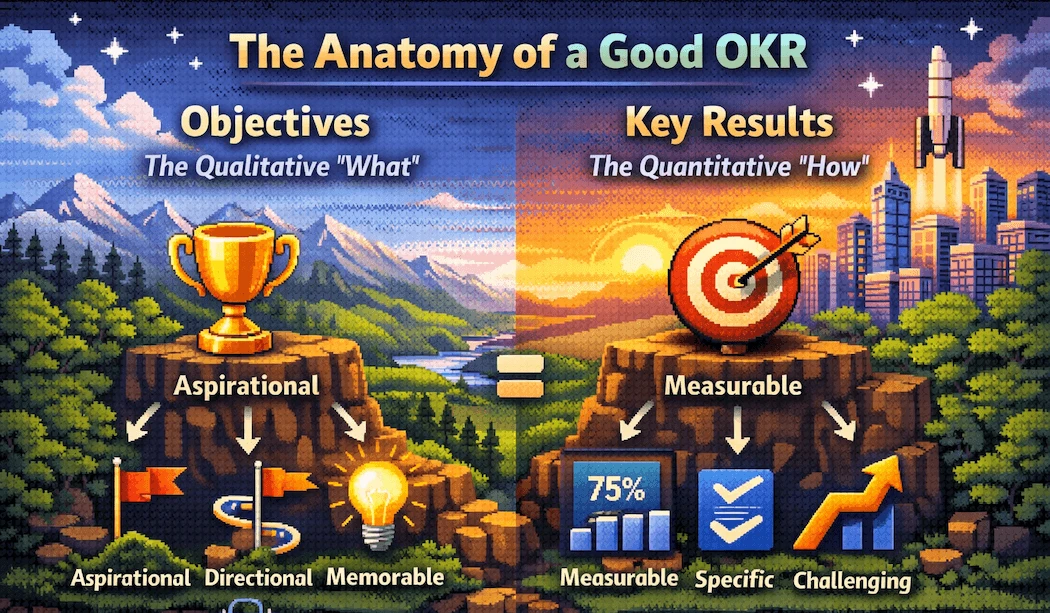
Understanding the structure is essential. An Objective should be qualitative, inspiring, and challenging. It answers "What do we want to achieve?" Key Results should be quantitative, time-bound, and verifiable. They answer "How will we know we've achieved it?"
Objectives: The Qualitative "What"
Good objectives are:
- Aspirational: They stretch beyond business-as-usual
- Directional: They point the team toward a clear outcome
- Memorable: You can recall them without looking them up
- Time-bound: They have a clear quarter or timeframe
Bad objectives are either too vague ("Improve customer experience") or too specific ("Launch feature X by March 15" that's a task, not an objective).
Key Results: The Quantitative "How"
Good Key Results are:
- Measurable: You can track progress with a number
- Specific: There's no ambiguity about what "done" looks like
- Challenging but achievable: 70-80% completion is the target
- Outcome-focused: They measure results, not activities
Each Objective should have 2-5 Key Results. More than that diffuses focus.
"OKRs by nature should be stretch goals. That helps you really think of different ways of achieving them out of the normal operations or the ordinary things that you already do usually."
Example OKRs by Function
| Function | Objective | Key Results |
|---|---|---|
| Product | Become the go-to solution for enterprise teams | 1. Increase enterprise trial-to-paid conversion from 15% to 25% 2. Achieve NPS of 50+ among enterprise accounts 3. Reduce time-to-first-value from 14 days to 5 days |
| Engineering | Deliver a reliable platform customers can depend on | 1. Achieve 99.95% uptime (currently 99.7%) 2. Reduce P1 incident response time from 30 min to 10 min 3. Decrease critical bug backlog from 47 to under 10 |
| Design | Create an intuitive experience that users love | 1. Reduce support tickets about UX confusion by 40% 2. Increase task completion rate in usability testing to 90% 3. Achieve SUS score of 80+ (currently 68) |
| Marketing | Establish thought leadership in our category | 1. Grow organic traffic from 50K to 100K monthly visitors 2. Generate 200 marketing qualified leads from content 3. Secure speaking slots at 3 industry conferences |
OKR Framework vs Other Goal Systems
The OKR framework isn't the only way to set goals. Understanding how it compares to other approaches helps you decide when to use it, and when not to.
OKRs vs KPIs
This is the most common confusion. KPIs (Key Performance Indicators) are ongoing metrics that measure business health. OKRs are temporary goals that drive change.
Think of it this way: KPIs tell you where you are. OKRs tell you where you want to go. A KPI might be "churn rate" you track it continuously. An OKR might be "reduce churn from 8% to 5% by Q2" a specific improvement goal. Once achieved, you set a new OKR while continuing to monitor the KPI.
They work together: KPIs often become the basis for Key Results when you want to improve them. For more on metrics, see 7 Product KPIs Every PM Should Track.
OKRs vs MBOs
Management by Objectives (MBOs), developed by Peter Drucker, is the predecessor to OKRs. The key differences:
- Cadence: MBOs typically annual; OKRs typically quarterly
- Ambition: MBOs often target 100% completion; OKRs target 70%
- Transparency: MBOs often private between manager and employee; OKRs typically visible organization-wide
- Flexibility: MBOs tend to be fixed; OKRs can be adjusted mid-cycle
OKRs vs SMART Goals
SMART goals (Specific, Measurable, Achievable, Relevant, Time-bound) share DNA with OKRs. The main difference is in the "A" SMART emphasizes achievable, while OKRs emphasize ambitious. SMART goals work well for operational targets where hitting 100% is expected. OKRs work better when you want to push beyond the comfortable.
Implementing the OKR Framework in Your Team
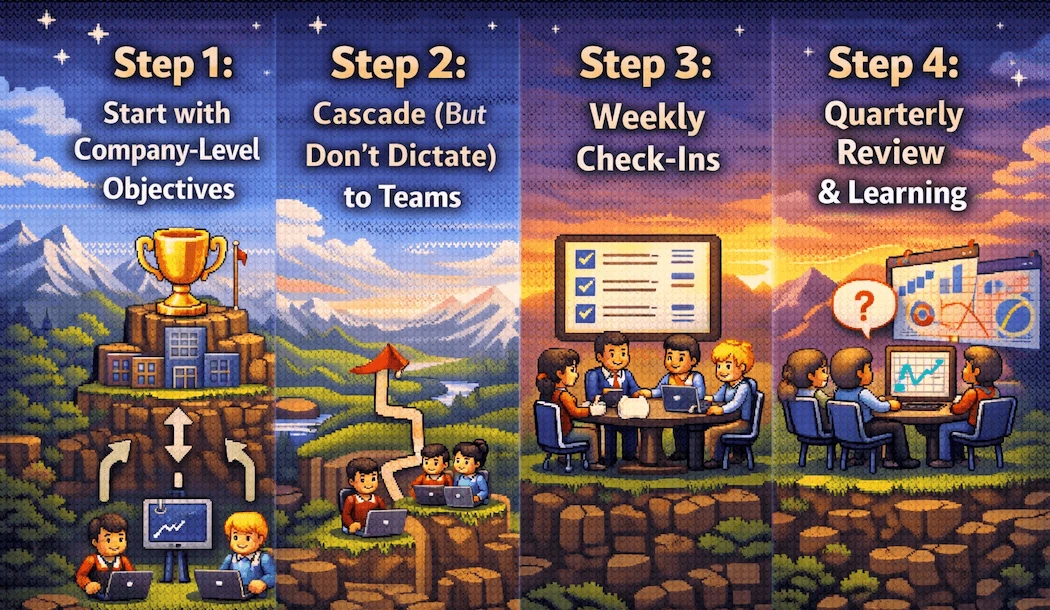
Implementation is where most OKR initiatives fail. Here's a practical approach that works.
Step 1: Start with Company-Level Objectives
Leadership must set clear company objectives first. Without this anchor, team OKRs become disconnected wish lists. Company objectives should be few (3-5 maximum) and represent the critical priorities for the quarter or year.
"Setting bold goals empowers and enables people to think broader and think outside the box to be more creative to achieve those big goals."
Step 2: Cascade (But Don't Dictate) to Teams
Teams should understand how their work connects to company objectives, but they should own their own OKRs. The recommended split is 40% top-down (aligned to company priorities) and 60% bottom-up (team-driven based on their expertise and customer insights).
This balance creates alignment without micromanagement. Teams closest to the work often see opportunities and obstacles that leadership misses.
Step 3: Weekly Check-Ins
This is the highest-leverage intervention you can make. According to Mooncamp's OKR statistics, teams that review their OKRs weekly achieve 43% higher goal completion rates compared to those that only check in quarterly.
Weekly check-ins don't need to be long. A 15-minute team standup covering OKR progress, blockers, and confidence levels is enough. The habit of regular attention matters more than the length of discussion.
Step 4: Quarterly Review and Learning
At quarter end, score your OKRs honestly. Google uses a 0-1.0 scale where 0.6 - 0.7 is the target range. Consistently scoring 1.0 means you're not being ambitious enough. Consistently scoring below 0.3 means something went wrong with goal-setting or execution.
More important than the score: what did you learn? What would you do differently? What surprised you? These insights inform better OKRs next quarter. For detailed planning guidance, see the Practical OKR Planning Guide.
Scoring and Grading OKRs
How you measure OKR success matters. The scoring system you choose shapes behavior, get it wrong and you undermine the entire framework.
The Google Scoring System
Google uses a 0.0 to 1.0 scale for scoring Key Results:
- 0.0 - 0.3: Failed to make real progress
- 0.4 - 0.6: Made progress but fell short of completion
- 0.7 - 1.0: Delivered on or exceeded the target
The "sweet spot" is 0.6 - 0.7 across your OKRs. This range indicates you set ambitious goals and made meaningful progress. Consistently scoring below 0.3 suggests either poor goal-setting or poor execution. Consistently scoring 1.0 suggests you're not being ambitious enough.
Committed vs. Aspirational OKRs
Some organizations distinguish between two types of OKRs:
Committed OKRs are promises. You're expected to achieve them fully. These often represent foundational work or hard commitments to stakeholders. Score them on a 100% or 0% basis, you either delivered or you didn't.
Aspirational OKRs are stretch goals. They represent your ambition and push the organization to grow. You expect to achieve 70% of these. Falling short isn't failure, it's learning.
When teams confuse these categories, frustration follows. A committed OKR that only hits 70% is a problem. An aspirational OKR that hits 100% probably wasn't ambitious enough.
What Scoring Is Not
Critical point: OKR scores are not performance reviews. They're learning tools. Using OKR achievement for compensation or promotion decisions creates perverse incentives. Teams will sandbag their goals to ensure they hit 100%. Innovation dies. Growth stalls.
Keep OKR scoring separate from performance management. Judge people on their contribution, judgment, and growth, not on whether they hit arbitrary numbers.
Common OKR Framework Mistakes
I've seen these patterns repeatedly in organizations struggling with OKRs. Avoid them.
Mistake 1: Treating Key Results as Tasks
"Launch new onboarding flow" is a task. "Increase onboarding completion from 40% to 70%" is a Key Result. Tasks describe activities. Key Results describe outcomes. You might complete every task on your list and still fail to move the Key Result, which means you didn't actually achieve what mattered.
Mistake 2: Setting Too Many Objectives
More than 3-5 objectives per team dilutes focus. If everything is a priority, nothing is. The power of OKRs comes from forcing hard choices about what matters most. Teams with 10 objectives are really just maintaining a to-do list.
Mistake 3: Expecting 100% Achievement
When teams consistently hit 100% of their OKRs, something is wrong. Either they're sandbagging with easy goals, or they've confused OKRs with performance commitments. The 70% target exists because stretch goals should stretch.
"OKRs are definitely about communication. If the frame is not clearly set around the whole tool of using OKRs, it can lead to frustration within teams."
Mistake 4: No Weekly Check-Ins
Setting OKRs in January and reviewing them in March is a recipe for failure. Without regular attention, OKRs become artifacts rather than tools. The check-in habit is more important than perfecting the initial OKRs.
Mistake 5: Disconnecting OKRs from Strategy
OKRs should flow from product strategy. If your OKRs don't clearly connect to strategic priorities, they're just arbitrary goals. Ask: "If we achieve all our OKRs, will we have made meaningful progress on our strategy?" If the answer isn't a clear yes, revisit your OKRs.
For more on avoiding these pitfalls, see 5 OKR Best Practices That Actually Work.
Getting Started with OKRs
Don't try to implement OKRs perfectly across your entire organization on day one. That's how OKR initiatives die. Instead, follow a pragmatic path that builds momentum through small wins.
The First-Quarter Approach
Start small. Pick one team. Run one quarter. Learn from mistakes. Expand based on what works. Trying to roll out OKRs company-wide in your first cycle creates chaos, too many moving pieces, too little shared understanding, too much room for misalignment.
Focus on learning, not perfection. Your first OKR cycle will be messy. That's fine. The goal is to get better, not to get it right immediately. Teams that treat the first cycle as an experiment outperform those that expect instant success. Document what works and what doesn't. Adjust for the next quarter.
Expect 1-2 quarters to mature. Just like adopting any new framework, whether it's Scrum, Design Thinking, or anything else, OKRs take time to internalize. The first cycle teaches you how your organization thinks about goals. The second cycle starts to feel natural. By the third, you'll wonder how you worked without them.
Your First Week Action Plan
Here's a concrete plan to start OKRs this week:
Day 1: Draft your team's Objective. Gather your team for 30 minutes. Ask: "What's the most important thing we need to accomplish this quarter?" Write down the answers. Look for themes. Draft one Objective that captures the essence.
Day 2: Define Key Results. Take your Objective and ask: "How would we know we achieved this?" Identify 3-5 measurable outcomes. For each, define a baseline (where you are now) and a target (where you want to be).
Day 3: Sanity check. Share your draft OKRs with a peer or stakeholder. Ask: "Does this make sense? Is it ambitious enough? Are the Key Results truly measurable?" Refine based on feedback.
Day 4: Finalize and share. Lock in your OKRs. Share them with everyone who needs to know. Make them visible, a shared doc, a Slack channel, a poster on the wall. Visibility creates accountability.
Day 5: Schedule check-ins. Block 15 minutes each week to review OKR progress. Put it on the calendar. Make it non-negotiable. The weekly habit is more important than the initial OKRs.
Building an OKR Culture
Invest in communication. OKRs fail when they're treated as a private ritual between manager and team. The framework works because of transparency. Share OKRs across teams. Discuss them in all-hands meetings. Make progress visible. When people see what others are working toward, they naturally find ways to help.
Celebrate the misses. This sounds counterintuitive, but it's essential. When a team shares that they only achieved 60% of an ambitious OKR, celebrate the learning. What did they discover? What will they do differently? Teams that hide failures don't learn from them. Teams that share failures create organizational wisdom.
Iterate the system, not just the goals. After each cycle, ask: "How can we make our OKR process better?" Maybe your check-ins are too long. Maybe your objectives are too vague. Maybe you're not involving the right people in goal-setting. Continuous improvement applies to the OKR system itself.
The 83% of companies who report positive impact from OKRs didn't get there by copying Google's OKR template. They got there by committing to the practice, learning from failures, and gradually building a culture where ambitious, measurable goals are how work gets done.
Start this week. Set one Objective. Define three Key Results. Check in on Friday. See what you learn.
I am happy to discuss implementation challenges on LinkedIn.