50+ User Interview Questions That Uncover Real Insights
According to Forrester Research, every dollar invested in UX returns $100. That is a 9,900% ROI. Yet most teams leave this value on the table because they ask the wrong questions in user interviews.
The difference between a breakthrough insight and wasted research time often comes down to a single word in your question. Ask "Would you use this feature?" and you will get polite agreement. Ask "Tell me about the last time you tried to solve this problem" and you will uncover the truth.
This guide gives you 50+ battle-tested user interview questions organized by product discovery phase. You will also learn which questions kill insights (so you can avoid them) and a framework for crafting questions that reveal what users actually need.
Why Interview Questions Matter
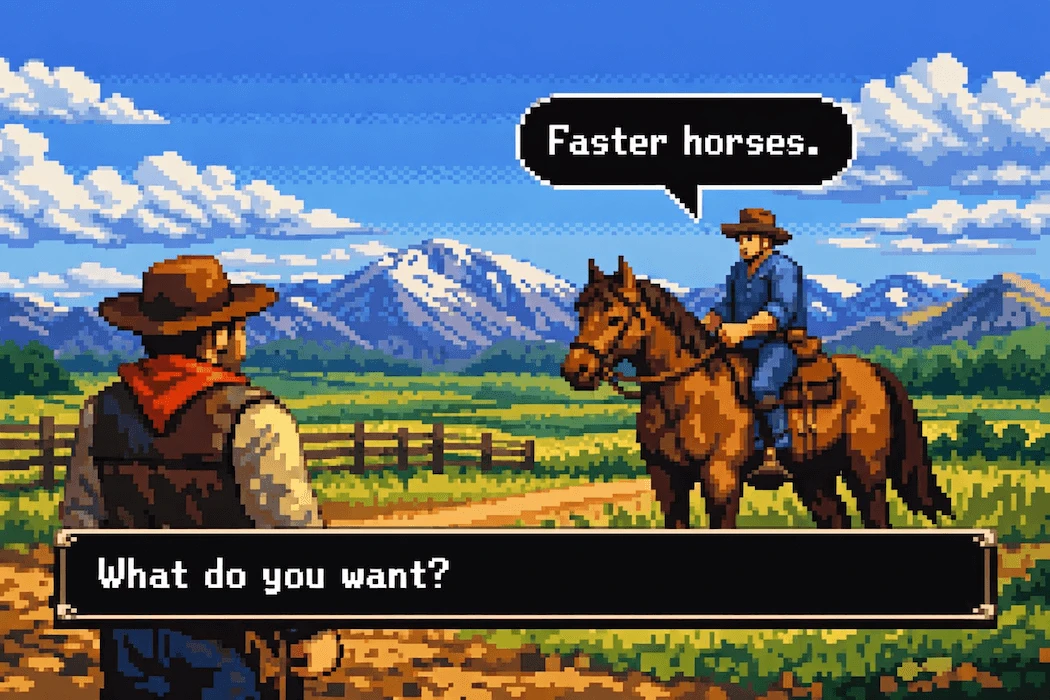
User interviews are the foundation of customer development. 89% of product teams conduct user interviews, making them the most widely used research method. But quantity does not equal quality.
"Starting with why is a big one. The more you explain that why, the more you empower teams." Cindy Alvarez, GitHub
The questions you ask determine the insights you get. Leading questions confirm your biases. Open questions reveal unexpected truths. The best interviewers treat each conversation as an opportunity to be proven wrong.
Good interview questions share three characteristics:
- Open-ended: They cannot be answered with yes or no
- Past-focused: They ask about actual behavior, not hypothetical futures
- Problem-centered: They explore pain points before jumping to solutions
Questions That Kill Insights (What NOT to Ask)
Before diving into what to ask, you need to understand what destroys research value. These question patterns feel natural but produce misleading data.
Leading Questions
Leading questions telegraph the answer you want. Users pick up on this and tell you what you want to hear.
| Bad Question | Why It Fails | Better Alternative |
|---|---|---|
| "Don't you think this design is cleaner?" | Implies the expected answer | "How does this design compare to what you use now?" |
| "How much do you love our new feature?" | Assumes positive sentiment | "What has your experience been with this feature?" |
"Would you agree that checkout is frustrating?"
Plants the emotion
"Walk me through your last checkout experience."
Yes/No Questions
Binary questions cut off exploration. You get a data point but no understanding.
- Bad: "Do you use our mobile app?"
- Better: "Tell me about how you typically access our service."
- Bad: "Is the navigation confusing?"
- Better: "How do you find what you need on our site?"
Future-Focused Questions
People are terrible at predicting their own behavior. What they say they will do rarely matches what they actually do.
"You should never ask a user 'did you ever try to press this button?'"
- Bad: "Would you pay $50 for this?"
- Better: "Tell me about the last product you purchased in this category. What did it cost?"
- Bad: "Will you use this feature daily?"
- Better: "How often do you currently do this task?"
The Why-First Framework
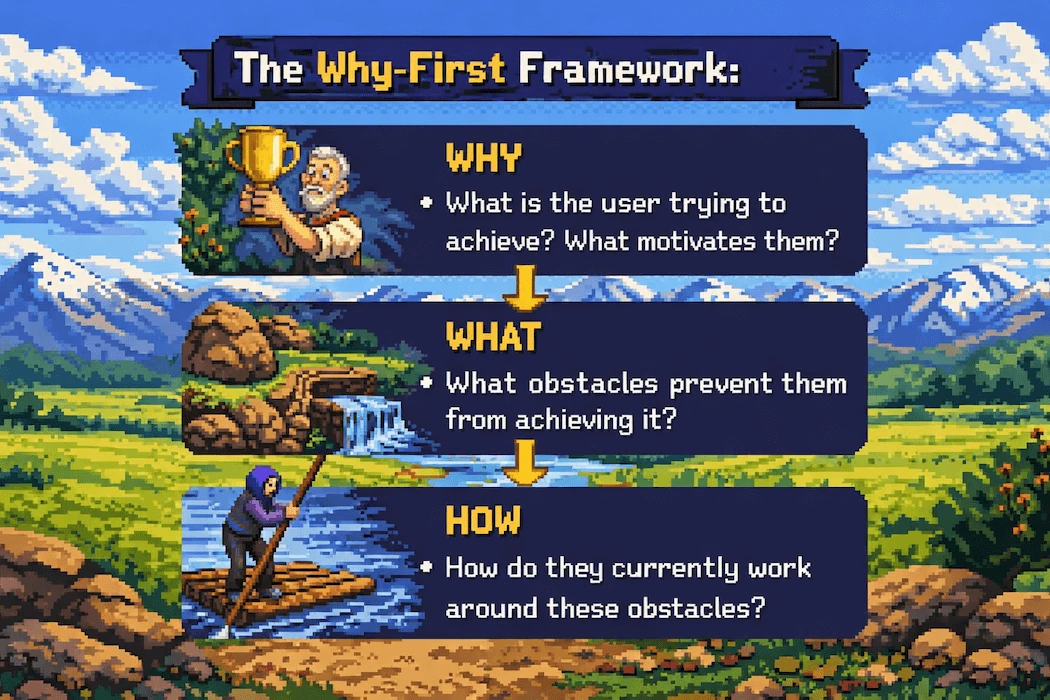
Great interview questions follow a simple principle: understand the problem before exploring solutions. This approach comes from customer development methodology.
"Customer development focuses on solutions that solve customer problems AND can be sustainably built." Cindy Alvarez, GitHub
The Why-First Framework has three layers:
- Why: What is the user trying to achieve? What motivates them?
- What: What obstacles prevent them from achieving it?
- How: How do they currently work around these obstacles?
Only after understanding all three should you explore potential solutions. This prevents you from building features that solve the wrong problem elegantly.
50+ User Interview Questions by Phase
The following questions are organized by where you are in the product discovery process. Start with discovery questions, then move to validation, usability, and post-launch as your product matures.
Phase 1: Discovery Questions (15 Questions)
Use these questions when you are exploring a problem space. The goal is to understand pain points and current behavior without biasing toward any solution.
Problem Exploration
1. "Tell me about the last time you tried to [accomplish goal]. What happened?"
2. "What is the hardest part about [process/task]?"
3. "When you think about [topic], what frustrates you most?"
4. "What would you say is your biggest challenge with [area]?"
5. "Describe a recent situation where [problem area] caused you difficulty."
Current Behavior
6. "Walk me through how you currently handle [task]."
7. "What tools or methods do you use for [activity]? Why those specifically?"
8. "How much time do you spend on [task] in a typical week?"
9. "Who else is involved when you [do activity]?"
10. "What have you tried in the past to solve this problem?"
Context and Motivation
11. "Why is solving this problem important to you right now?"
12. "What happens if this problem does not get solved?"
13. "Tell me about your role and how [topic] fits into your work."
14. "What does success look like for you in this area?"
15. "If you could wave a magic wand and fix one thing about [process], what would it be?"
Phase 2: Validation Questions (15 Questions)
Use these questions when you have a concept or early prototype. The goal is to test whether your solution addresses real needs.
Solution Fit
16. "Based on what I showed you, how would this fit into your current workflow?"
17. "What would need to change for you to use something like this?"
18. "What questions do you have about how this would work?"
19. "What concerns would you have about switching to this approach?"
20. "How does this compare to what you use today?"
Concept Testing
21. "In your own words, what do you think this product does?"
22. "Who else in your organization might benefit from this?"
23. "What features seem most valuable? Least valuable?"
24. "What is missing that would make this more useful?"
25. "If this existed today, when would you use it?"
Prioritization and Value
26. "How would you rank these features in order of importance to you?"
27. "What problem does this solve that is worth paying for?"
28. "Tell me about a similar product you purchased recently. What convinced you to buy?"
29. "What would make you stop using your current solution?"
30. "Who would need to approve a purchase like this at your company?"
Phase 3: Usability Questions (10 Questions)
Use these questions during usability testing. The goal is to identify friction points and comprehension issues.
"Five to seven users per segment. That is the magic number for usability testing." Nikki Anderson, User Research Lead at Zalando
Task Completion
31. "Without clicking anything yet, where would you go to [accomplish task]?"
32. "Walk me through what you are thinking as you try to [complete task]."
33. "What did you expect to happen when you clicked that?"
34. "On a scale of 1-7, how difficult was it to complete that task? Why?"
35. "What would you do next if you encountered this in real life?"
Comprehension and Navigation
36. "What do you think [specific element/label] means?"
37. "Is anything on this page confusing or unclear?"
38. "What information is missing that you would need to make a decision?"
39. "How does this page compare to others you have used for similar tasks?"
40. "If you were stuck here, what would you do?"
Phase 4: Post-Launch Questions (10 Questions)
Use these questions after launch to measure satisfaction and identify improvement opportunities.
Satisfaction and Adoption
41. "How has your experience been with [product/feature] so far?"
42. "What do you use [product] for most often?"
43. "What features have you not used yet? Why?"
44. "How likely are you to recommend [product] to a colleague? Why that score?"
45. "What almost made you stop using [product]?"
Improvement and Expansion
46. "If you could change one thing about [product], what would it be?"
47. "What do you wish [product] could do that it does not do today?"
48. "What tasks do you still use other tools for?"
49. "How has [product] changed the way you work?"
50. "What would you tell someone who is considering using [product]?"
Bonus: Emotional and Contextual Questions (5 Questions)
51. "How did you feel the last time you had to deal with [problem]?"
52. "What is the best experience you have had with a product like this?"
53. "If [product category] did not exist, what would you do instead?"
54. "What do people misunderstand about your role or needs?"
55. "What keeps you up at night regarding [topic area]?"
Follow-Up Techniques
The questions above are starting points. The real insights come from follow-up questions that dig deeper into initial responses.
Essential Follow-Up Phrases
- "Tell me more about that." Opens space for elaboration without directing the response.
- "Why is that?" Uncovers motivation behind behavior. Use it repeatedly (the "5 Whys" technique).
- "Can you give me an example?" Grounds abstract statements in concrete reality.
- "You mentioned [X]. What did you mean by that?" Clarifies terms that might have different meanings.
- "How did that make you feel?" Accesses emotional responses that reveal priority.
The Power of Silence
After asking a question, wait. Most interviewers rush to fill silence, but pauses often prompt the richest responses. Count to five in your head before speaking again.
Mirroring Technique
Repeat the last few words of what the user said as a question. This encourages them to continue without introducing your bias.
User: "I gave up and just used a spreadsheet."
You: "Used a spreadsheet?"
User: "Yeah, because the export function never worked right and I needed the data for my weekly report..."
Sample 30-Minute Interview Script
Here is a template you can adapt for discovery interviews:
Opening (3 minutes)
"Thank you for taking the time to speak with me. I am researching how people [topic area] and would love to learn from your experience. There are no right or wrong answers. I am here to learn, not to sell anything. Feel free to be completely honest."
Background (5 minutes)
- "Tell me about your role and how [topic] fits into your work."
- "How long have you been doing [activity]?"
Core Questions (15 minutes)
- "Walk me through the last time you [did activity]."
- "What was the hardest part?"
- "What have you tried to make this easier?"
- "Why is solving this important to you?"
Wrap-Up (5 minutes)
- "Is there anything else about [topic] that I should have asked?"
- "Would you be open to a follow-up conversation if we have more questions?"
Closing (2 minutes)
"Thank you so much for your time. Your insights are incredibly valuable. We will follow up if we need any clarification."
Getting Started This Week
You do not need to use all 55 questions in every interview. Start here:
- Pick your phase: Are you discovering problems, validating solutions, testing usability, or gathering feedback?
- Select 8-10 questions: Choose from the relevant section above.
- Schedule one interview: Reach out to a customer, prospect, or internal stakeholder.
- Record and review: Capture the conversation (with permission) and note surprises.
- Iterate: Adjust your questions based on what worked.
For a complete overview of research approaches, see the user research methods guide. If you are specifically testing a prototype, the usability testing guide covers best practices in depth.
"Product managers are anthropologists. They are students of human behavior." Rich Mironov
The best interview questions come from genuine curiosity about user problems. Ask questions you actually want answered, listen more than you talk, and be willing to discover that your assumptions were wrong.
That willingness to be wrong is where the real insights live.

Need A Product Coach?
I help founders and product leads fix what's actually broken, hands-on. See how I can help.