OKRs vs KPIs: What's the Difference and When to Use Each
OKRs are a goal-setting framework. KPIs are metrics. That one distinction clears up 90% of the confusion between these two concepts. OKRs tell you where you want to go and drive change. KPIs tell you where you are now and monitor health. They serve different purposes, and the best teams use both.
Here's the quick comparison:
- OKRs (Objectives and Key Results): A framework for setting ambitious, time-bound goals that drive specific outcomes
- KPIs (Key Performance Indicators): Ongoing metrics that track business health and operational performance
- Key difference: OKRs are temporary (quarterly), KPIs are continuous
- Best practice: Use KPIs to monitor, use OKRs to improve, use both together for alignment
The Core Difference: GPS vs. Dashboard
The simplest way to understand OKRs vs KPIs is through a car analogy. Think of KPIs as your car's dashboard: the speedometer, fuel gauge, and temperature indicator. They tell you the current state of your vehicle. You glance at them continuously to make sure everything is running smoothly.
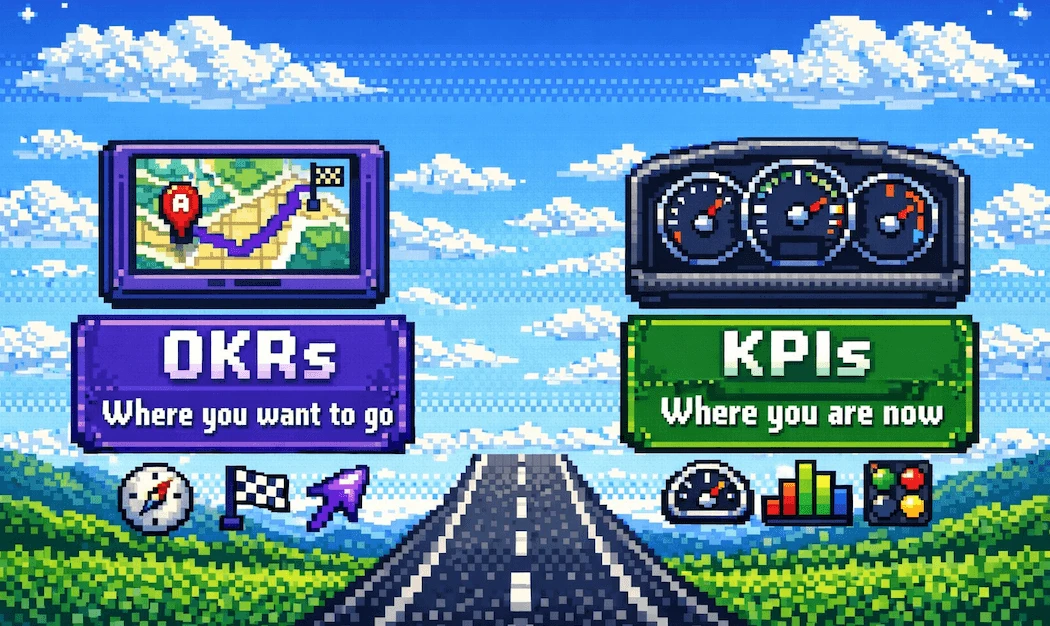
OKRs are like your GPS navigation system. They show you a destination and the route to get there. You set a destination (Objective), and the GPS tracks your progress toward it (Key Results). Once you arrive, you set a new destination.
You need both. A dashboard without a GPS means you're monitoring a car that's going nowhere. A GPS without a dashboard means you might run out of fuel before reaching your destination. The same is true for OKRs and KPIs in business: they complement each other.
What Are KPIs?
KPIs (Key Performance Indicators) are quantifiable metrics that measure how well your business or product is performing against its objectives. They track ongoing health and provide continuous visibility into operations.
"You need success metrics based on facts. Otherwise you can't argue or justify anything." Matthias Kluge, Churn Optimization Expert
KPIs answer the question: "How are we doing right now?" They're the vital signs of your business. Common product KPIs include:
- Churn rate: Percentage of customers who stop using your product
- Monthly Recurring Revenue (MRR): Predictable revenue from subscriptions
- Net Promoter Score (NPS): Customer satisfaction and loyalty
- Daily Active Users (DAU): Engagement and product stickiness
- Activation rate: New users who complete key actions
The key characteristic of KPIs is that they're continuous. You track them week after week, month after month. A KPI like "churn rate" doesn't have an end date. You monitor it indefinitely because it reflects ongoing business health.
For more on the metrics every PM should track, see my guide on 7 essential product KPIs.
What Are OKRs?
OKRs (Objectives and Key Results) are a goal-setting framework for driving specific outcomes within a defined timeframe. The Objective describes what you want to achieve. The Key Results measure how you'll know you've achieved it.
"The purpose of analytics is to protect you from lying to yourself." Ben Yoskovitz, Co-author of Lean Analytics
OKRs answer the question: "What do we want to change?" They're temporary by design. Most organizations set OKRs quarterly, though some use annual cycles. Once the cycle ends, you assess results and set new OKRs.
Here's a typical OKR example for a product team:
Objective: Become the most-loved project management tool for remote teams
- KR1: Increase NPS from 35 to 55
- KR2: Reduce onboarding time from 7 days to 3 days
- KR3: Achieve 80% weekly active usage among new users
Notice how the Key Results are measurable outcomes, not tasks. "Launch a new onboarding flow" is a task. "Reduce onboarding time from 7 days to 3 days" is a Key Result. OKRs focus on outcomes, not outputs.
For a complete framework, see my guide to the OKR framework.
OKRs vs KPIs: Key Differences
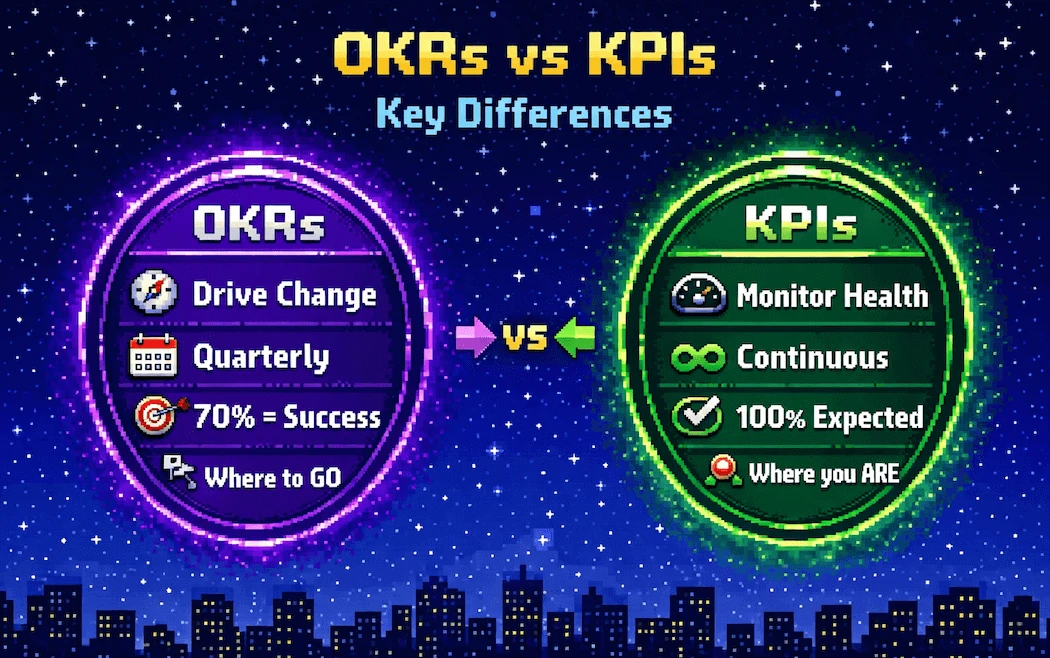
Here's a side-by-side comparison of OKRs and KPIs:
| Aspect | OKRs | KPIs |
|---|---|---|
| Purpose | Drive change and improvement | Monitor ongoing health |
| Timeframe | Quarterly (typically) | Continuous |
| Ambition Level | Stretch goals (70% = success) | Targets (100% expected) |
| Format | Objective + 3-5 Key Results | Metric + Target |
| Review Cycle | Weekly check-ins, quarterly reset | Real-time or periodic |
| Focus | Where you want to go | Where you are now |
| Question Answered | "What should we achieve?" | "How are we performing?" |
The most important difference is ambition level. KPIs typically have targets you expect to hit 100% of the time. If your churn rate target is 5%, you want to actually achieve 5% or less. But OKRs are designed as stretch goals. According to Google's re:Work, achieving 70% of an ambitious OKR is considered success.
When to Use KPIs vs OKRs
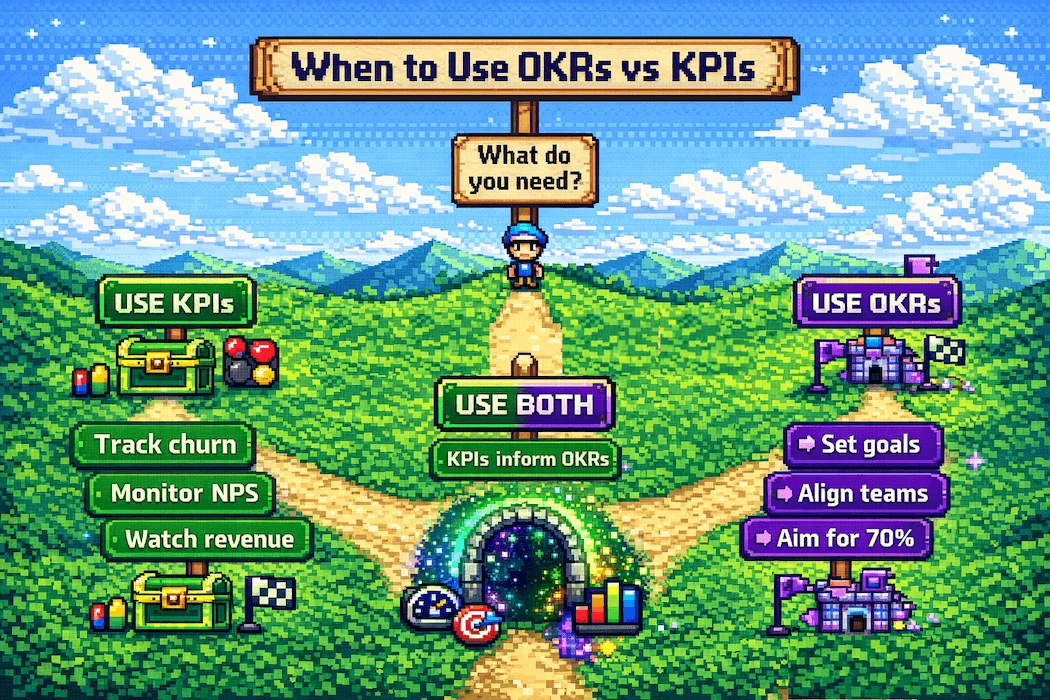
The choice between KPIs and OKRs depends on what you're trying to accomplish. Here's a decision framework:
Use KPIs When:
- Monitoring ongoing business health: Revenue, churn, engagement metrics that need continuous tracking
- Tracking operational performance: Support response time, uptime, error rates
- Providing visibility to stakeholders: Dashboards and reports that show current state
- Benchmarking against competitors: Industry-standard metrics for comparison
Use OKRs When:
- Driving specific improvements: Moving a metric from X to Y by a deadline
- Aligning teams on priorities: Creating shared focus across the organization
- Pursuing ambitious stretch goals: Pushing beyond business-as-usual
- Managing transformation initiatives: Changing how your organization operates
Use Both Together When:
- KPIs inform OKR priorities: A declining KPI signals where to focus your next OKR
- KPIs become Key Results: Improving a KPI from X to Y is a natural Key Result
- Teams need both visibility and direction: Most mature organizations use both
How OKRs and KPIs Work Together
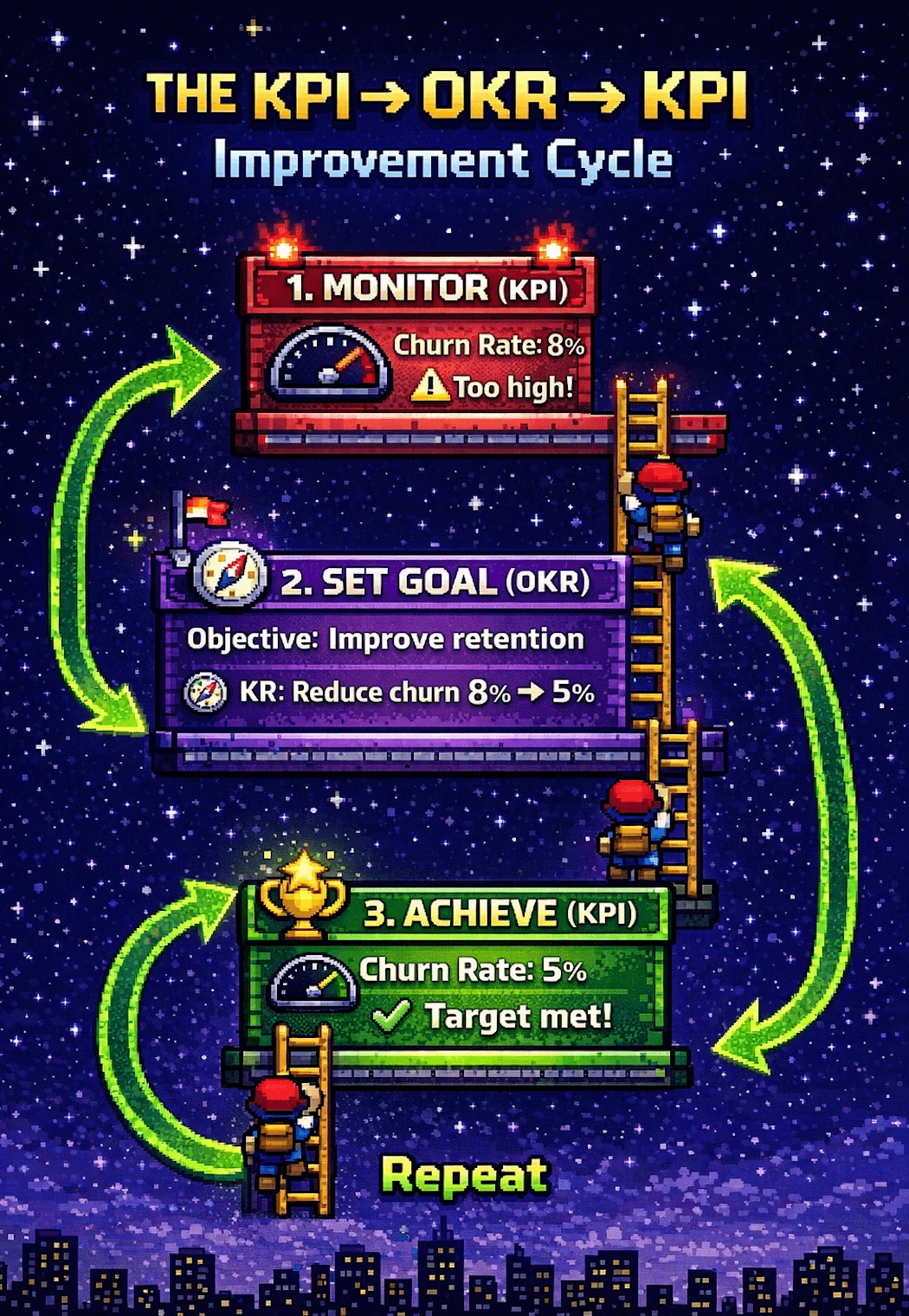
The real power comes from using OKRs and KPIs together in a continuous improvement cycle.
"It's not about exclusively using data. It's not about being so wholly data driven that you ignore your gut or insights or anything else." Ben Yoskovitz, Co-author of Lean Analytics
Here's how the cycle works:
- Monitor your KPIs. You track churn rate continuously and notice it's at 8% monthly.
- Identify a problem. 8% churn is too high. It's hurting growth and revenue.
- Create an OKR. Objective: Dramatically improve customer retention. KR1: Reduce monthly churn from 8% to 5%.
- Execute and track. Work on the OKR for the quarter, checking progress weekly.
- Achieve and reset. At quarter end, churn is at 5.5%. You hit 80% of your target.
- Update your KPI baseline. Your ongoing churn KPI now monitors at the new, lower level.
The data on this approach is compelling. According to a study by Haufe Talent and Stuttgart University, 78% of employees using OKRs report job satisfaction compared to only 65% in companies without OKRs. The same study found that 72% of workers using team OKRs understand company vision versus approximately 50% without them.
The pattern of "KPI as Key Result" is one of the most effective ways to bridge the two concepts. Your KPIs tell you what needs attention. Your OKRs provide the focused effort to improve those metrics.
Common Mistakes When Comparing OKRs and KPIs
I've seen teams struggle with OKRs and KPIs for years. Here are the four most common mistakes:
Mistake 1: Treating KPIs as OKRs
Writing "Churn rate: 5%" and calling it an OKR misses the point. A standalone metric without context isn't an OKR. An OKR needs an inspiring Objective and multiple Key Results that work together toward that objective.
Wrong: "KR: Churn rate 5%"
Right: "Objective: Build a product customers love. KR1: Reduce churn from 8% to 5%. KR2: Increase NPS from 35 to 50. KR3: Achieve 90% feature adoption for core workflows."
Mistake 2: Using OKRs for Monitoring
OKRs are designed to drive change, not monitor status quo. If you're just tracking existing metrics without improvement targets, use KPIs. Reserve OKRs for when you want to move the needle.
Mistake 3: Too Many KPIs Without Prioritization
Tracking 50 metrics doesn't make you data-driven. It makes you data-overwhelmed. The best teams ruthlessly prioritize their KPIs to focus on what actually matters. Three to five KPIs per team or product area is usually sufficient.
Mistake 4: Not Connecting KPIs to Strategic OKRs
If your KPIs don't ladder up to strategic priorities, you're measuring activity without purpose. Every KPI should connect to something the organization cares about. If you can't explain why a KPI matters for strategy, question whether you should track it.
For more on setting effective goals, see my guide on OKR best practices.
Examples: OKRs vs KPIs for Product Teams
Here's a practical comparison showing how the same business area uses both OKRs and KPIs:
| Business Area | KPIs (Monitor) | OKRs (Improve) |
|---|---|---|
| User Engagement | DAU: 10.000 WAU: 35.000 Session length: 8 min | Objective: Make our product an essential daily tool KR1: Increase DAU from 10.000 to 25.000 KR2: Grow average session length from 8 to 15 minutes |
| Customer Retention | Monthly churn: 6% NPS: 42 Support tickets: 500/week | Objective: Build a product customers can't live without KR1: Reduce monthly churn from 6% to 4% KR2: Increase NPS from 42 to 55 KR3: Decrease support tickets from 500 to 300/week |
| Revenue Growth | MRR: €50.000 ARPU: €25 Conversion rate: 3% | Objective: Establish sustainable revenue engine KR1: Grow MRR from €50.000 to €80.000 KR2: Increase conversion rate from 3% to 5% KR3: Raise ARPU from €25 to €35 |
Notice the pattern: KPIs show the current state with no timeframe. OKRs show a desired future state with specific targets. The KPIs continue to be monitored even after the OKR cycle ends.
Making the Right Choice for Your Team
The question isn't "OKRs or KPIs?" It's "How do we use both effectively?" Here's a practical approach:
- Start with your product strategy. What are the key outcomes you need to achieve? What metrics indicate success?
- Establish your core KPIs. Identify 3-5 metrics that represent ongoing business health. Track these continuously.
- Set quarterly OKRs for improvement. Look at your KPIs and strategy. Where do you need to move the needle? Set ambitious OKRs for those areas.
- Review and iterate. At quarter end, assess your OKRs. Update your KPI targets based on achievements. Set new OKRs for the next priority.
For a complete OKR planning process, see my practical guide to OKRs.
Conclusion
OKRs and KPIs aren't competing frameworks. They're complementary tools that serve different purposes. KPIs provide the continuous visibility you need to monitor business health. OKRs provide the focused effort you need to drive change.
The best organizations use both: KPIs to know where they are, and OKRs to get where they want to go. Like a dashboard and GPS in your car, you need both to reach your destination efficiently.
You are also welcome to continue the conversation on LinkedIn.

Need A Product Coach?
I help founders and product leads fix what's actually broken, hands-on. See how I can help.