Customer Discovery: How to Find What Customers Actually Need
35% of startups fail because there's no market need for what they built. Not because of bad code. Not because of poor marketing. Because they never validated that customers would actually pay for what they were building.
Customer discovery is the systematic process of finding out if your business idea solves a real problem that customers will pay to solve. It's the difference between guessing what customers need and knowing what they'll buy.
In this guide, you'll learn the exact customer discovery process used by Cindy Alvarez, Director of Customer Research at GitHub and author of "Lean Customer Development." You'll get practical techniques including her "magic wand" question and stock questions that work in any conversation.

What Is Customer Discovery?
Customer discovery is the first phase of the customer development process, where you validate that a real market exists for your product before building it. Unlike product discovery (which focuses on what to build), customer discovery focuses on who to build for and whether they'll pay.
The core question: Do customers have this problem, and will they pay to solve it?
Customer discovery involves three key activities:
- Identifying your customer segment: Who exactly has this problem?
- Validating the problem: Is the problem painful enough to motivate action?
- Testing willingness to pay: Will customers exchange money for a solution?
This is different from user research, which often happens after you have a product. Customer discovery happens before you build anything significant. It's about de-risking your investment of time and money.
Customer Research vs User Research
The distinction matters. User research studies how people interact with your product. Customer research studies whether people will become customers in the first place.
Cindy Alvarez draws a clear line between the two approaches:
"User research focuses on the person using the software who's not necessarily paying you. Customer development looks at not just what someone says they want, but what is the reality they exist within? What is the reality of the business cases you have?"
Customer discovery combines both perspectives: understanding user needs while validating the business case. You need solutions that solve real problems AND that you can sustainably build and support.
Why Customer Discovery Matters
The data is stark. According to CB Insights research, "no market need" is the top reason startups fail. All that engineering time, all those late nights, all that capital, wasted because nobody validated demand first.
Customer discovery prevents this by forcing you to confront reality early. Before you've invested months of development time. Before you've spent your runway. Before you've hired a team around an unvalidated idea.
But here's the uncomfortable truth about doing customer discovery well:
"The first pitfall that most companies fall into is not being ready to hear the answers. Because once you start talking to customers, they will answer in ways you don't expect and they will answer in ways that contradict your deeply held beliefs." Cindy Alvarez, GitHub
Effective customer discovery requires more than just talking to potential customers. It requires being genuinely open to learning that your assumptions are wrong. That's harder than it sounds.
When to Do Customer Discovery
Customer discovery is most valuable at specific moments:
- Before building a new product: Validate demand before writing code
- Before entering a new market: Understand if your solution transfers
- When growth stalls: Discover if market needs have shifted
- Before major pivots: Validate the new direction before committing
The earlier you do customer discovery, the cheaper mistakes become. A conversation costs an hour. Building the wrong product costs months.
The 5-Step Customer Discovery Process
Here's a practical framework for running customer discovery that actually produces actionable insights.
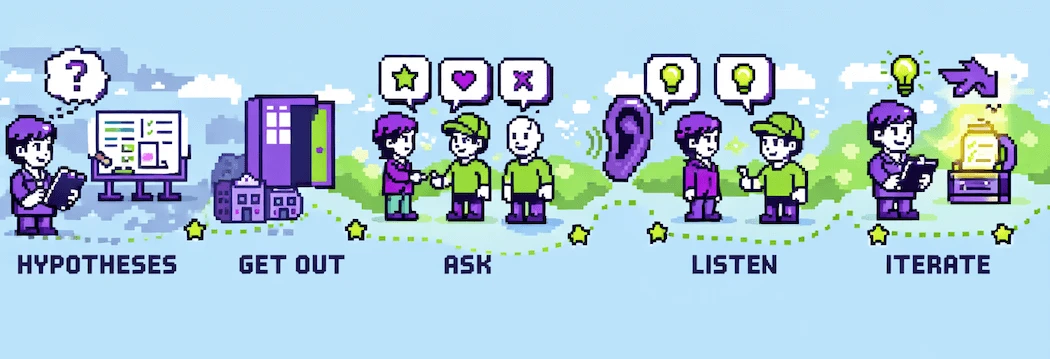
Step 1: State Your Hypotheses
Don't start with a blank slate. Start with explicit assumptions you want to test. Write down:
- Customer hypothesis: Who specifically has this problem? (Job title, company size, industry, situation)
- Problem hypothesis: What problem do they have? How painful is it?
- Value hypothesis: Will they pay for a solution? How much?
Making hypotheses explicit forces clarity. "Small businesses" is too vague. "Freelance designers with 3-10 active clients who struggle to track project profitability" is testable.
The goal isn't to be right. It's to have something specific to validate or invalidate. Every interview should help you refine or reject your hypotheses.
Step 2: Get Out of the Building
Customer discovery requires talking to real potential customers, not people in your office. But it doesn't always require formal scheduled interviews.
Lightweight research methods work surprisingly well for early validation:
- Social media: Post a question on Twitter or LinkedIn and see what responses you get
- Support channels: If you have any product in market, use support conversations as research opportunities
- Community forums: Monitor Reddit, Stack Overflow, or industry-specific forums for problem discussions
- Sales conversations: Mine existing sales calls for insights about customer problems
"I often say that it's hard to engage in a lot of research if you don't know the questions you should be asking. Sometimes that Twitter post reveals the questions that you should be asking." Cindy Alvarez, GitHub
These lightweight methods help you discover what questions to ask before you invest in formal research. They're not a replacement for in-depth interviews, but they're a valuable starting point.
Step 3: Ask the Right Questions
The questions you ask determine the insights you get. Bad questions produce misleading answers. Good questions reveal truth.
Stock Questions That Work
Cindy Alvarez recommends developing "stock questions" proven questions you can use repeatedly without having to think on your feet. This reduces the skill barrier for doing customer research:
"You don't have to be super confident to ask a customer what's the most important thing you need to solve." Cindy Alvarez, GitHub
Some reliable stock questions for customer discovery:
- "What's the most important thing you need to solve in [area]?"
- "Tell me about the last time you tried to [accomplish goal]. What happened?"
- "What's the hardest part about [process]?"
- "What have you tried before to solve this?"
- "How much time or money does this problem cost you?"
The Magic Wand Question
When conversations get stuck or you want to break through surface-level answers, use the magic wand question:
"If you could wave a magic wand, what outcome would you want?" Cindy Alvarez, GitHub
This question cuts through constraints and reveals true desires. It works in multiple contexts:
- With customers: Breaks them out of asking only for "reasonable" features
- With stakeholders: Surfaces underlying goals when teams are arguing about solutions
- With your team: Reveals what people really want when they're hesitant to say it
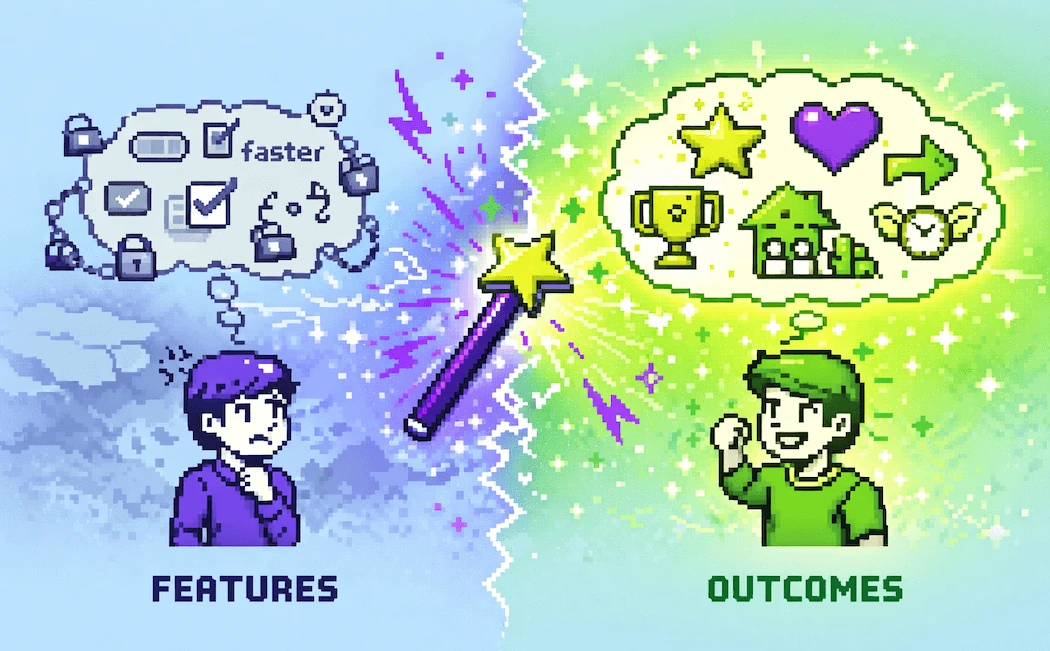
The magic wand question is powerful because it gives people permission to dream. Often what they dream about reveals the core problem better than their stated feature requests.
For a comprehensive list of interview questions organized by discovery phase, see the guide to user interview questions.
Step 4: Listen Without Bias
The hardest part of customer discovery isn't getting meetings. It's actually hearing what customers tell you.
Confirmation bias makes you hear what you want to hear. You remember the customer who validated your idea and forget the three who didn't. You interpret ambiguous statements as agreement.
To listen without bias:
- Record conversations: With permission, record interviews so you can review them without your memory filtering
- Look for disconfirming evidence: Actively search for signals that contradict your hypothesis
- Have someone else analyze: A colleague without your emotional investment might hear things differently
- Count responses: Track how many customers say X vs Y, patterns emerge from numbers
Remember Cindy's warning: customers will say things that contradict your beliefs. That discomfort is information. Don't dismiss it.
Step 5: Evaluate and Iterate
After 15-20 conversations, step back and evaluate your hypotheses:
- Validate: Evidence consistently supports your hypothesis
- Invalidate: Evidence consistently contradicts your hypothesis
- Refine: Partial support suggests your hypothesis needs adjustment
If your hypotheses are invalidated, that's not failure, that's learning. You've just saved months of building the wrong thing. Pivot your hypotheses and run another round of discovery.
If your hypotheses are validated, you have permission to move forward. Start building an MVP and continue learning through usability testing as you iterate.
Customer Discovery vs Product Discovery
These terms are often confused. Here's the practical difference:
| Dimension | Customer Discovery | Product Discovery |
|---|---|---|
| Core Question | Who is the customer? Will they pay? | What should we build? What solves the problem? |
| When | Before building, when validating market | Ongoing, when deciding what to build next |
| Output | Validated customer segment and value proposition | Product roadmap, feature priorities |
| Methods | Problem interviews, landing page tests, smoke tests | Solution interviews, prototypes, usability tests |
| Risk Addressed | Will customers buy this? | Can we build something customers want to use? |
Customer discovery typically comes first. Once you've validated that customers exist and will pay, product discovery helps you figure out exactly what to build for them.
For a complete overview of research approaches you can use across both phases, see the user research methods guide.
Common Customer Discovery Mistakes
These patterns derail customer discovery efforts. Avoid them.
Mistake 1: Not Being Ready to Hear Answers
This is the pitfall Cindy identifies as most common. Teams go through the motions of customer discovery but aren't actually open to learning. They:
- Dismiss negative feedback as "that customer doesn't get it"
- Only remember conversations that confirm their beliefs
- Ask leading questions that produce the answers they want
- Cherry-pick quotes that support their predetermined conclusion
The fix: Before starting discovery, commit as a team to what evidence would change your mind. Write it down. Then hold yourself accountable to it.
Mistake 2: Asking Leading Questions
"Don't you think this would be useful?" is not research, it's a push poll. Leading questions telegraph the answer you want, and polite people give it to you.
Instead of asking "Would you use this feature?" ask "How do you currently handle this situation?" The first invites false positives. The second reveals actual behavior.
Mistake 3: Confusing Features with Problems
Customers often ask for features when they mean to describe problems. "I need a dashboard" might mean "I can't quickly see if things are on track." The dashboard is one possible solution. Understanding the underlying problem opens up many solutions.
When customers request features, ask: "What would that allow you to do?" Keep asking until you reach the underlying need.
Mistake 4: Skipping the "Why" Behind Requests
Every customer request has layers. "Make it faster" might mean "I'm frustrated by waiting" or "My boss yells at me when reports are late" or "I'm trying to process more volume." Each "why" suggests different solutions.
Use the "five whys" technique: keep asking why until you reach the root motivation. The surface request rarely tells the whole story.
Mistake 5: Talking to the Wrong People
Customers who will talk to you aren't always customers who will buy from you. Early adopters, friends, and fellow founders often give encouraging feedback that doesn't predict market success.
Seek out:
- People who have the problem (not just might have it)
- People with budget authority (not just influencers)
- People who've tried other solutions (not just people who've done nothing)
Mistake 6: Treating Discovery as a Phase
Customer discovery isn't something you complete and move on from. Markets change. Customer needs evolve. Competitors move first.
Build ongoing customer contact into your routine. The insights from continuous discovery compound over time. Teams that stay close to customers build better products than teams that check the "discovery" box once and never return.
Getting Started Today
You don't need a research budget, a UX team, or executive approval to start customer discovery. You need curiosity and willingness to learn.
This Week
- Write down your hypotheses: Who is your customer? What problem do they have? Will they pay?
- Identify 5 potential customers: Real people, not abstractions. People you can actually contact.
- Schedule one conversation: 30 minutes. Use the stock questions above. Record it with permission.
This Month
- Complete 10-15 interviews: Patterns emerge around this number
- Document your learnings: What validated? What invalidated? What surprised you?
- Refine your hypotheses: Update based on evidence, not hope
Going Forward
Make customer conversations a habit, not a project. The best product teams talk to customers every week, not just when launching something new. That ongoing contact builds intuition that no amount of data can replace.
For a complete overview of research methods you can use beyond interviews, explore the user research methods guide. Once you've validated customer demand, learn how to translate insights into product-market fit.

Need A Product Coach?
I help founders and product leads fix what's actually broken, hands-on. See how I can help.